Software Testing
Become proficient in Software Testing and Quality Assurance in manual and automated testing.
- Conversational sessions between the students and faculty.
- Assisted and Applied Learning through real-world projects.
- In-depth understanding of manual and automated testing with tools.
- Personalized mentoring

World-Class Instructors

1:1 with Industry Mentors

55% Avg. Salary Hike

Interview Preparation
World-Class Instructors
1:1 with Industry Mentors
55% Avg. Salary Hike
Interview Preparation
Automated Software Testing Course in Bangalore
Techpragna’s Automated Software Testing Course paves the way for all aspirants to emerge as testers in their dream companies. Equip yourself with our industry-based curriculum to secure a future that you never dreamt of.
Prominent Features – Training on Software Testing
- Proficiency in top software testing tools.
- Learn Core and Advanced Concepts
- Real-World Projects that never give a feel of a fresher.
- Conversational online and classroom sessions exclusively taken by industry experts.
- Roadmap and Guide to crack tough interviews.
- Definite employment support.
Request more information
What You’ll Learn
Accelerate your career in software testing with our Software Testing Training at Tech Pragna in Bangalore. This comprehensive course equips you with the skills and techniques to ensure software quality, automate tests, and identify defects—perfect for both beginners and working professionals
Software Testing Training – Key Features
- Master Essential Tools: Selenium, JIRA, Postman, LoadRunner, TestNG, and Jenkins
- Learn Core Concepts: Test planning, manual testing, automation testing, performance testing, and defect management
- Hands-On Projects: Work on real-world testing scenarios and practical test automation
- Live Interactive Sessions: Attend online and offline sessions led by top industry professionals
- Live online and offline interactive sessions from top industry professionals
- Guaranteed placement support through our career advancement services
Request more information
Syllabus: Automation Software Testing Course
Module 1:Getting Started with Software Testing
- Software Development Life Cycle (SDLC)
- Software Testing Life Cycle (STLC)
- Roles & Responsibilities of QA Engineer
- Verification vs Validation
- Quality Assurance vs Quality Control
- Types of Software Testing
- Manual vs Automation Testing
Module 2: Basics of QA Testing
- Principles of Software Testing
- Levels of Testing (Unit, Integration, System, UAT)
- Functional vs Non-Functional Testing
- Black Box vs White Box Testing
- Static vs Dynamic Testing
- Test Environment Setup
- Test Planning & Strategy
- Entry & Exit Criteria
Module 3: Introduction to Manual Testing
- Requirement Analysis
- Test Scenario Creation
- Writing Effective Test Cases
- Test Case Review Process
- Test Data Preparation
- Test Execution Process
- Requirement Traceability Matrix (RTM)
- Test Summary Report
Module 4:Techniques used in Software Test Designs
- Equivalence Partitioning
- Boundary Value Analysis
- Decision Table Testing
- State Transition Testing
- Use Case Testing
- Error Guessing
- Pairwise Testing
- Exploratory Testing
Module 5:Defect Detection & Management
- Defect Life Cycle
- Bug Reporting Standards
- Severity vs Priority
- Root Cause Analysis
- Defect Tracking Tools Overview
- Defect Metrics
- Retesting & Regression Testing
- Defect Closure Process
Module 6: Software Testing using Agile & Scrum
- Introduction to Agile Methodology
- Scrum Framework
- Roles in Scrum (PO, SM, Team)
- Sprint Planning & Daily Stand up
- Writing User Stories
- Acceptance Criteria & DoD
- Testing in Agile Environment
- Sprint Review & Retrospective
Module 7: Management tools for Software Testing
- ntroduction to Jira
- Creating Projects in Jira
- Writing & Managing Test Cases
- Bug Tracking in Jira
- Dashboards & Reports
- Workflow Configuration
- Integration with Test Tools
- Real-Time Project Practice
Module 8:Getting Started with Automation Testing
- Need for Automation
- Automation Testing Life Cycle
- Types of Automation Frameworks
- Selecting Automation Tools
- ROI of Automation Testing
- Automation vs Manual Comparison
- Basic Programming Concepts
- Setting up Automation Environment
Module 9:Selenium Testing for Java Programs
- Introduction to Selenium
- WebDriver Architecture
- Locators & Web Elements
- Handling Dropdowns & Alerts
- Frames & Windows Handling
- Synchronization (Waits)
- TestNG Framework
- Data-Driven Testing
Module 10: Developing Frameworks
- Page Object Model (POM)
- Hybrid Framework Design
- Maven Integration
- Logging with Log4j
- Screenshot Handling
- Reporting with Extent Reports
- Exception Handling
- Real-Time Framework Project
Module 11: Getting Started with API Testing
- Introduction to API Testing
- HTTP Methods & Status Codes
- JSON & XML Basics
- Introduction to Postman
- Creating API Requests
- Validating API Responses
- API Automation Concepts
- Integration with Automation Framework
Module 12: Testing of Databases
- ntroduction to S QL
- SELECT Queries
- Joins & Subqueries
- Data Validation Techniques
- Connecting Application with Database
- CRUD Operations Testing
- Stored Procedures Testing
- Backend Validation Scenarios
Module 13: Testing - Performance and Security
- Introduction to Performance Testing
- Load vs Stress Testing
- Basics of JMeter
- Performance Metrics Analysis
- Introduction to Security Testing
- OWASP Top Vulnerabilities
- Authentication & Authorization Testing
- Basic Security Testing Tools Overview
Module 14: Version Control – CI/CD
- Introduction to Jenkins
- Continuous Integration Concepts
- Pipeline Creation
- Git Basics for Testers
- Branching Strategy
- Integration with Selenium
- Automated Build Execution
- Real-Time CI/CD Implementation
Module 15 : Project Work & Career Preparation
- End-to-End Real-Time Project
- Agile Project Simulation
- Resume Preparation
- LinkedIn Profile Optimization
- Mock Interviews (Technical)
- HR Interview Preparation
- Live Project Deployment
- Placement Assistance Guidance
Master In-Demand Skills with Practical, Industry-Based Learning
What Role Does a Software Testing Professional Play?
Manual Tester
Executes test cases to identify bugs and ensure software meets quality standards through detailed reporting
Test Analyst
Analyzes requirements and business processes to design effective test plans and recommend quality improvements
Automation Tester
Develops automated test scripts using tools like Selenium to increase testing efficiency and coverage
Performance Tester
Conducts load and stress testing to evaluate application performance and scalability under different conditions
Test Engineer
Builds and maintains test environments, integrates testing into CI/CD pipelines, and supports test automation frameworks
QA Consultant
Provides expert guidance to organizations on improving testing processes, quality assurance strategies, and defect management
Skills Covered
Test Planning
Manual Testing
Test Automation
Performance Testing
Defect Tracking
SQL Querying
Scripting (Python/Java)
Test Case Design
Continuous Integration
Quality Assurance Practices
Software Testing Tools Covered

Manual Tester
Examines and executes the test cases of apps to check for bugs to ensure functionality that meets user requirements
Test Analyst
Analyzes requirements and business processes to design effective test plans and recommend quality improvements
Automation Tester
Develops automated test scripts using tools like Selenium to increase testing efficiency and coverage
Performance Tester
Evaluates the application loading speed in terms of performance and scalability by conducting stress tests.
Test Engineer
Develops, configures, and maintains test environments and automates testing within CI/CD pipelines to improve workflows.
QA Consultant
Provides customized guidance to organizations to improve QA strategies, testing, and defect management.
Skills Covered
Test Planning
Manual Testing
Test Automation
Performance Testing
Defect Tracking
SQL Querying
Scripting (Python/Java)
Test Case Design
Continuous Integration
Quality Assurance Practices
Software Testing Tools Covered

Accelerating Career Services for aspirants in Software Testing


Guaranteed Placement

1:1 Mentoring Session with Guidance

Assistance in Interview Preparation

Assistance in Project Work

Practical Training Sessions

Building an impressive CV
Career Services
Placement Assistance
Personalized Guidance
Mock Interview Preparation
One-on-One Mentoring session
Career Oriented Seesions
Resume & LinkedIn Profile Building
How our program works
Enhance Your Skills to Transform Your Career Path
- Justify your software testing certification via technical knowledge and dedication to QA.
- Enhance your career and employability chances with practical software testing projects
- Proficiency in tools and methodologies adopted by worldwide industries.
- Applied and experimental learning via practical assignments and love projects.
- Enhance your thinking capabilities and problem-solving skills.
- Awareness of the updates of evolving software testing trends in the market.
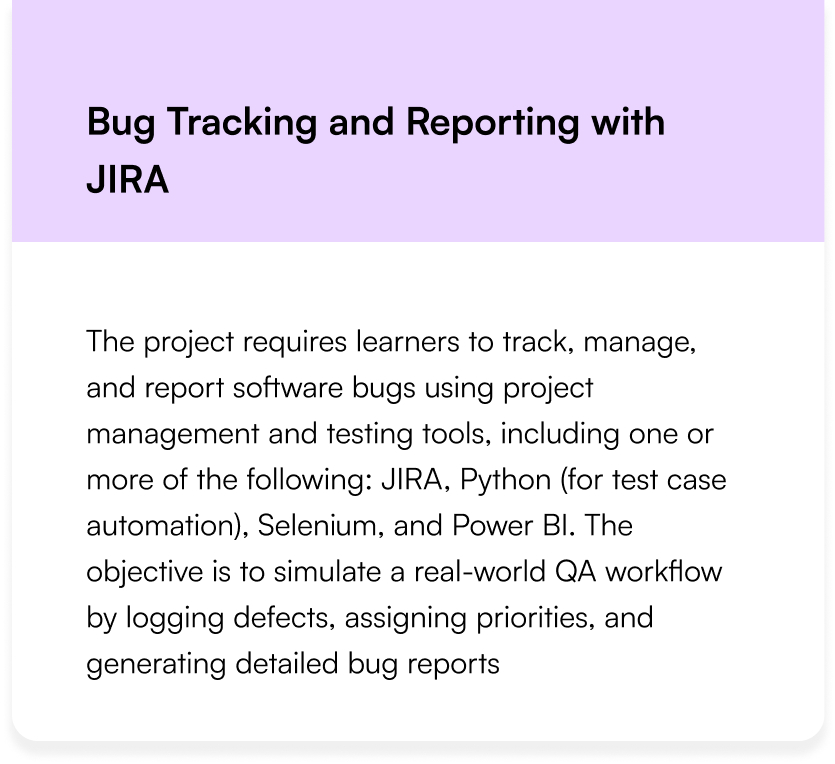
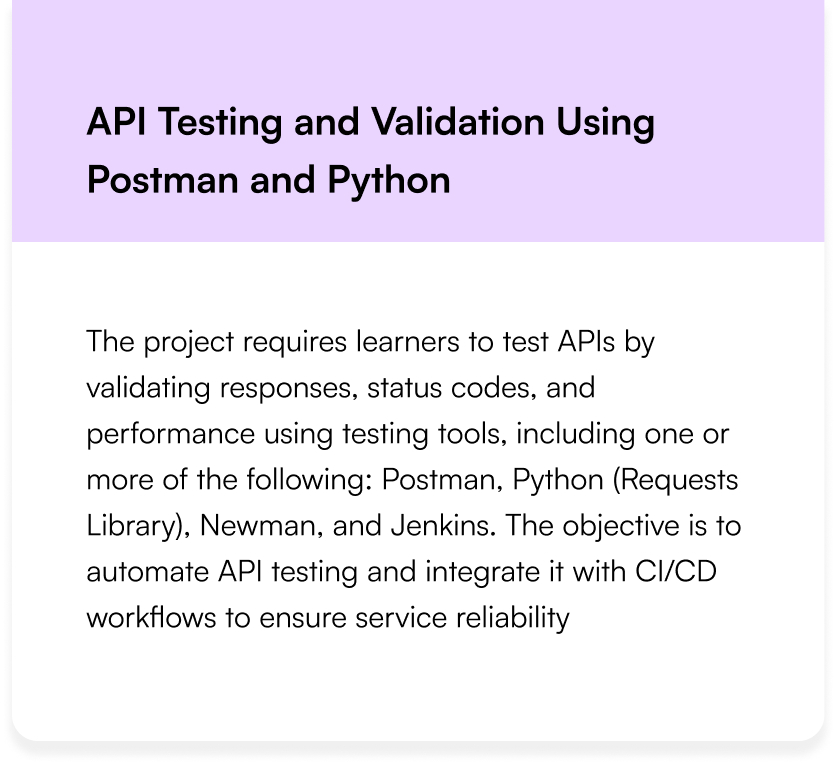
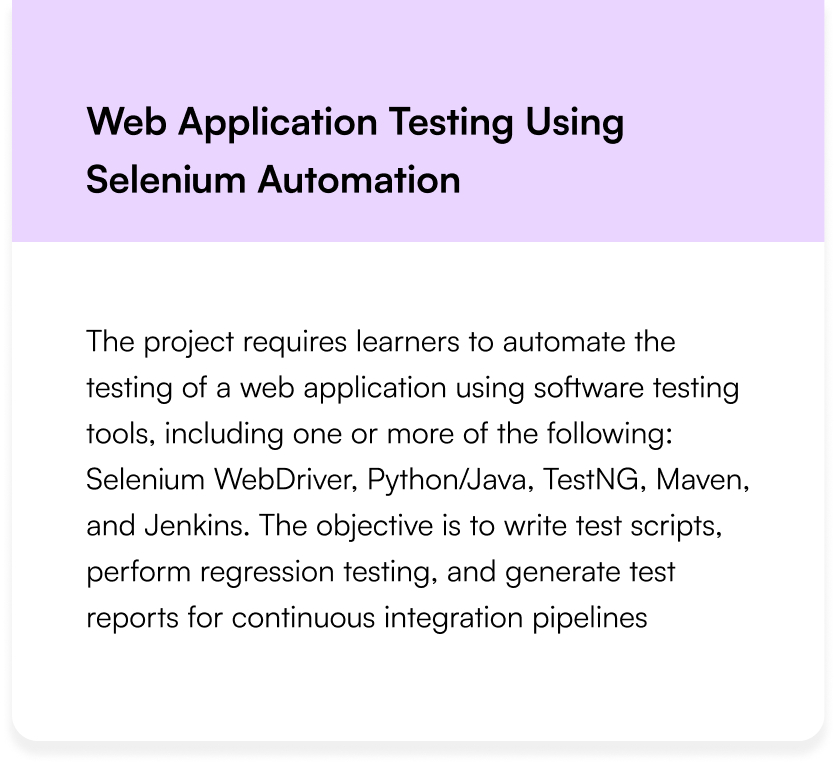
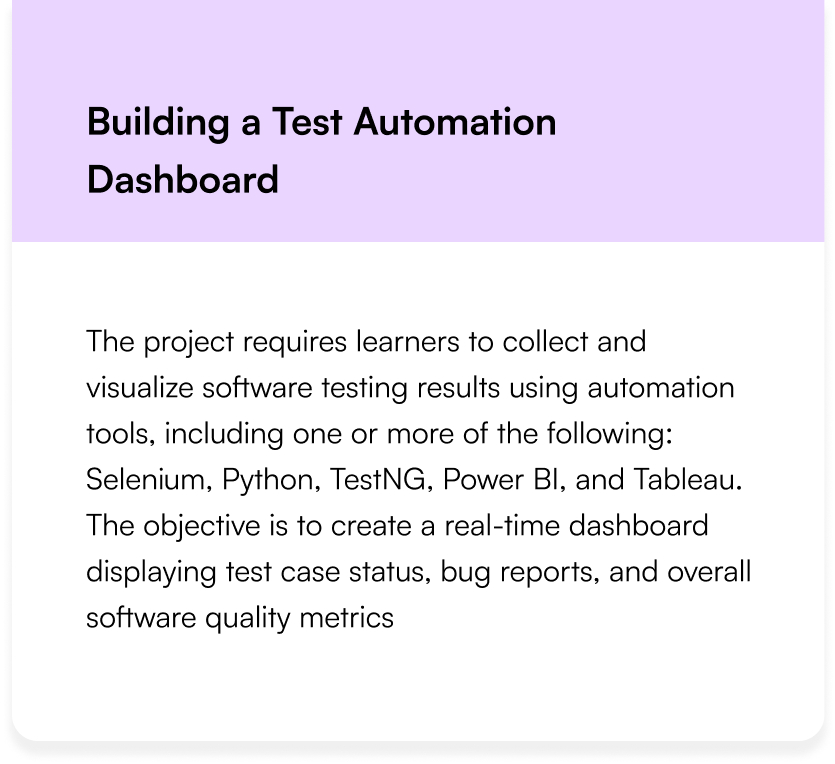
Software Testing Projects Covered
Land Your Dream Job Our Alumni
FAQs on Software Testing Course – Manual & Automated
Is programming experience required to become a tester?
Concerning manual testing, you don’t need programming knowledge or experience. However, for automation testing, performance testing, API testing, and Security Testing, basic programming knowledge would be an added advantage.
Is a Software Testing Course suitable for non-technical backgrounds?
The Software Testing Course is open to all educational backgrounds, whether technical or non-technical. Manual Testing Course is best suited for non-technical educational backgrounds.
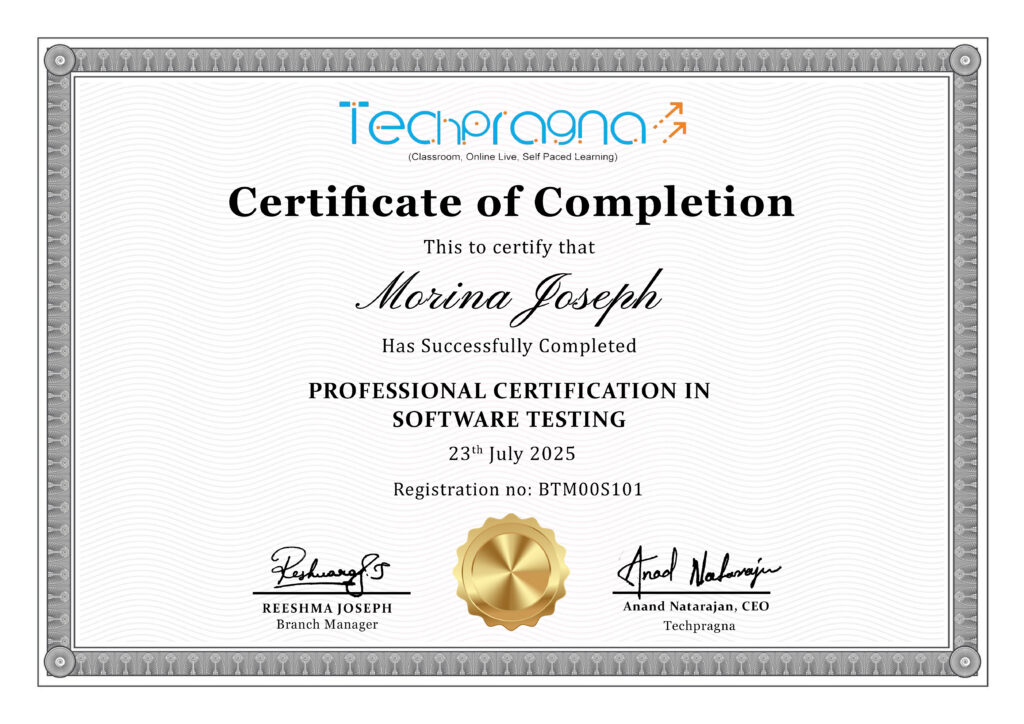
Will I get a certificate after successful completion of the course?
Yes, you will get the certificate recognized by industries worldwide.
What is the pay package of a software tester?
A software tester draws a pay package of Rs. 3 – 4LPA, while senior automation testers enjoy a salary package of Rs. 15 to 25 LPA.
Do you provide placement support?
At Techpragna, our courses are embedded with placement assistance, interview preparation, and creating a curriculum vitae that impresses your prospective employers.
What is the market demand for software testers?
The market demand for software testers is high, as many technical and non-technical companies hire testers and quality assurance professionals.
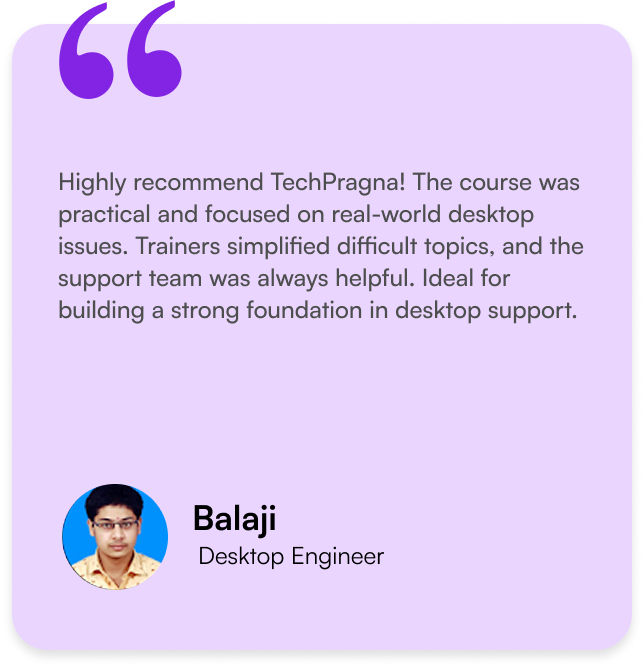
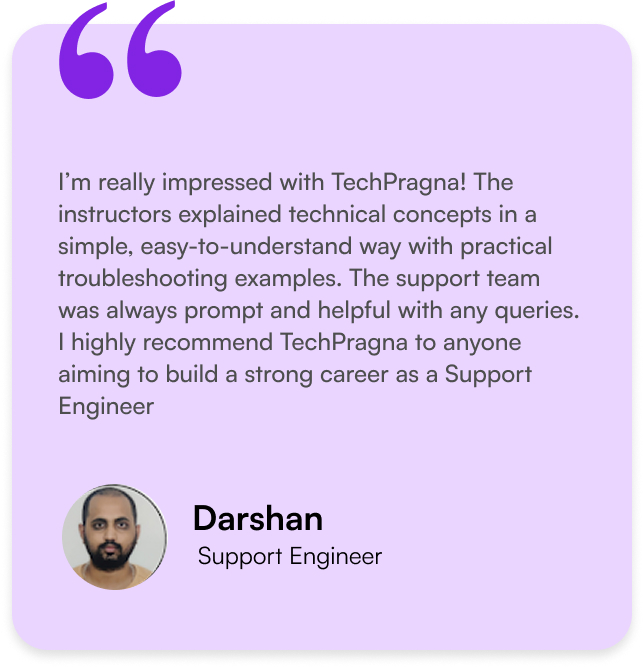
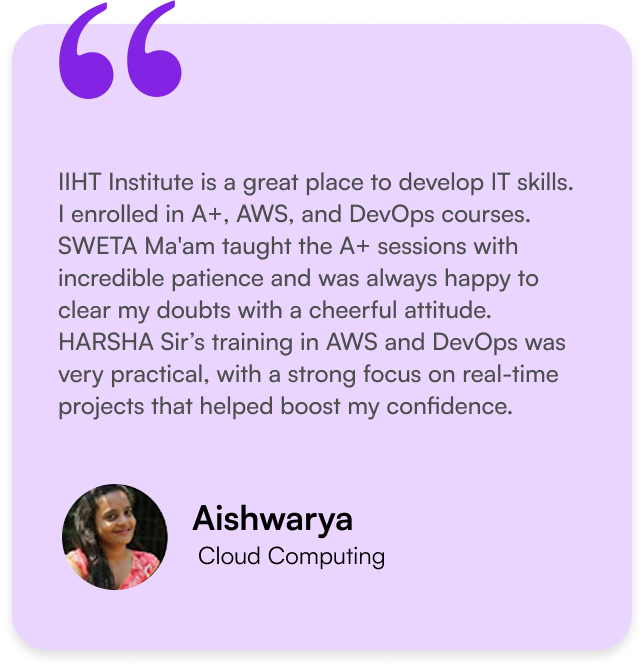
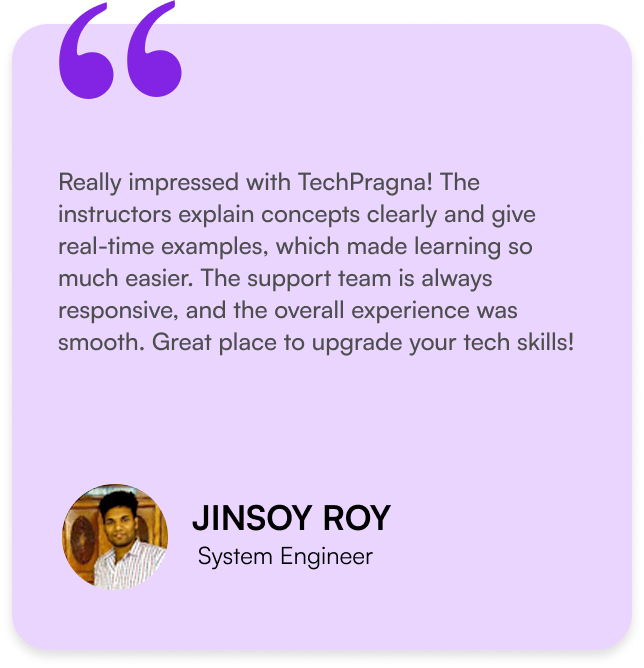
What Our Learners Have To Say
Explore the Latest Trending Courses

Cloud Computing
- Online/Offline
- 6 Months
- Professional Level Certification
- Projects and Case Study

Data Science
- Online/Offline
- 6 Months
- Professional Level Certification
- Projects and Case Study

Network Engineering
- Online/Offline
- 6 Months
- Professional Level Certification
- Projects and Case Study

Cyber Security
- Online/Offline
- 6 Months
- Professional Level Certification
- Projects and Case Study