Cloud Computing
Gain proficiency in cloud infrastructure, deployment skills, and hands-on experience.
- Become future-ready using AWS, MS-Azure, Google Cloud, Docker, Kubernetes, etc.
- Interactive classroom and online training from cloud computing industry professionals.
- Guaranteed employment in Fortune 500 Companies via our career services.
- Cloud Configuration, Virtualization, Security, and performance optimization skills at your fingertips.

World-Class Instructors

1:1 with Industry Mentors

55% Avg. Salary Hike

Interview Preparation
What is the takeaway from a cloud computing course?
Get a much-needed kickstart in your career with a profitable cloud computing course that comprehensively equips you with designing, deploying, and managing cloud infrastructure. Strengthen your portfolio & profile with 100% life-oriented projects to impress your hiring managers.
Cloud Offerings – Key Features
- Cloud Offerings – Hands-on experience with powerful tools such as DevOps, Docker, Kubernetes, Terraform, Jenkins, and more
- Unfair advantage over others by showcasing your skills in a professional cloud portfolio containing work on real-world cloud scenarios.
- Classroom & Virtual training with interactive sessions – flexible learning.
- Complete placement support.
- Higher engagement through industry expert-led classroom and online interactive classes.
- Receive project-based learning accompanied by end-to-end mentor project assistance, including doubt-clearing sessions.
- Budget-friendly fees with easy EMI options.
- Expert and highly experienced cloud professionals.
Request more information
Cloud Computing Course Curriculum
Module 1: Introduction to Cloud Computing & DevOps
- Overview of Cloud Computing concepts and types (Public, Private, Hybrid)
- Core DevOps principles and lifecycle
- Benefits of Cloud & DevOps in modern IT environments
- Cloud deployment models and service models (IaaS, PaaS, SaaS)
- Continuous Integration (CI) and Continuous Delivery (CD) concepts
- Overview of industry use-cases and career opportunities
Module 2: Linux for Cloud & DevOps
- inux basics: commands, file systems, and permissions
- Process management and shell scripting
- User and group management
- Package management and updates
- Networking basics on Linux
- Automating tasks using shell scripts
Module 3:Version Control with Git
- ntroduction to Git and version control concepts
- Git workflow: clone, commit, push, pull, branch, merge
- Resolving merge conflicts
- Git branching strategies (Gitflow, feature branching)
- Stashing, reverting, and tagging commits
- Practical exercises: collaborating on code repositories
Module 4: Continuous Integration (CI)
- CI concepts and benefits
- Introduction to Jenkins
- Creating and configuring pipelines
- Automated build and test execution
- Integration with version control systems
- Hands-on: building a CI pipeline for a sample project
Module 5: Continuous Deployment & Delivery (CD)
- CD principles and workflo w
- Pipeline automation for deployment
- Managing environments (Dev, Test, Staging, Production)
- Blue-Green and Canary deployment strategies
- Rollback mechanisms and error handling
- Hands-on: implementing a sample CD pipeline
Module 6:Configuration Management
- ntroduction to configuration management
- Overview of Ansible concepts and architecture
- Writing Ansible playbooks and roles
- Managing inventory files and variables
- Automating server configuration
- Hands-on: deploying web servers using Ansible
Module 7: Containerization with Docker
- ntroduction to containers and Docker architecture
- Docker images, containers, and registries
- Dockerfile creation and image building
- Managing container lifecycle
- Networking and volume management in Docker
- Hands-on: containerizing a sample application
Module 8: Orchestration with Kubernetes
- Kubernetes architecture and components
- Pods, Deployments, and Services
- ConfigMaps and Secrets management
- Scaling and self-healing applications
- Helm charts and application templating
- Hands-on: deploying containerized apps on Kubernetes
Module 9:Infrastructure as Code (IaC)
- ntroduction to IaC principles
- Overview of Terraform architecture
- Writing Terraform scripts for resource provisioning
- Managing state files and variables
- Modules and reusable code in Terraform
- Hands-on: provisioning virtual infrastructure using Terraform
Module 10:Monitoring & Logging
- mportance of monitoring and logging in DevOps
- Introduction to Prometheus for monitoring
- Grafana dashboards for visualization
- Collecting and analyzing logs with ELK stack (Elasticsearch, Logstash, Kibana)
- Setting alerts and notifications
- Hands-on: monitoring a sample application environment
Module 11:CI/CD Pipeline Integration
- Integrating Jenkins with Docker and Kubernetes
- Automating tests in CI/CD pipelines
- Deploying microservices through pipelines
- Managing secrets and credentials in pipelines
- Pipeline as code concepts
- Hands-on: end-to-end pipeline automation
Module 12:Security in Cloud & DevOps
- Cloud security concepts and best practices
- Role-based access control (RBAC)
- Secrets management and encryption
- Container security best practices
- DevSecOps integration in pipelines
- Hands-on: securing applications in a DevOps environment
Module 13: Networking & Load Balancing
- asics of networking for cloud and DevOps
- DNS, IP addressing, and routing concepts
- Load balancing techniques
- Reverse proxy and Nginx basics
- High availability setup
- Hands-on: deploying a load-balanced web application
Module 14: Automation & Scripting
- Advanced shell scripting techniques
- Automating deployments and configurations
- Writing scripts for monitoring and alerts
- Task scheduling with cron jobs
- Combining scripts with CI/CD pipelines
- Hands-on: automating end-to-end deployment
Module 15: Microservices Architecture
- Understanding monolithic vs microservices
- Designing microservices for cloud environments
- Containerization and orchestration in microservices
- Service discovery and communication
- Scaling and fault tolerance
- Hands-on: deploying a sample microservices application
Module 16: Capstone Project
- Designing a fully automated cloud infrastructure with CI/CD pipelines
- Implementing containerized microservices on Kubernetes
- Configuration management with Ansible
- Monitoring, logging, and alert setup
- Security and compliance implementation
- Presenting the project with a professional DevOps portfolio
Master In-Demand Skills with Practical, Industry-Based Learning
Roles that you get as a cloud computing professional
Techpragna’s Google Cloud Computing course offers the following job opportunities.
Cloud Engineer
Designs, deploys, and maintains cloud infrastructure to ensure scalable, secure, and cost-efficient solutions across AWS/Azure/GCP
Cloud Administrator
Monitors daily cloud operations, manages resources, optimizes costs, and ensures seamless performance of cloud services
Cloud Security Engineer
Implements security controls (IAM, encryption, firewalls), conducts vulnerability assessments, and ensures compliance with industry standards
Cloud Support Specialist
Provides technical support for cloud services, resolves issues, and assists users with deployment, storage, and networking challenges
Cloud Solutions Architect
Designs end-to-end cloud solutions aligned with business needs, including hybrid/multi-cloud strategies and serverless architectures
Cloud Consultant
Advises organizations on cloud adoption, migration strategies, cost optimization, and best practices for performance and security
Skills Covered
Cloud Deployment
Infrastructure as Code
AWS/Azure/GCP CLI
Automation Scripting
Cost Optimization
Containerization
IAM
Technical Documentation
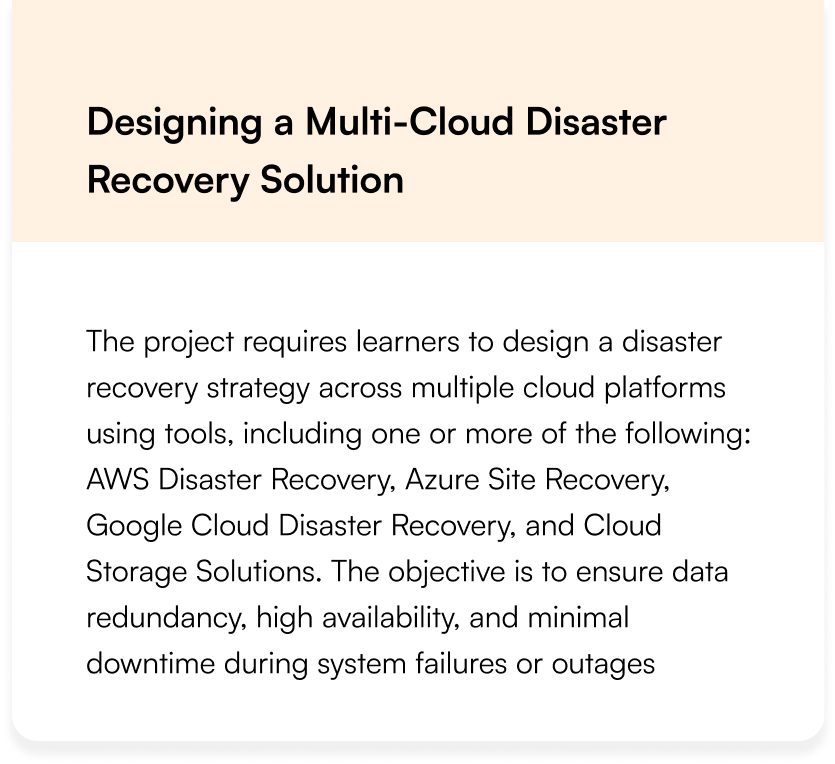
Disaster Recovery
Multi-Cloud Governance
12+ Cloud Computing Tools Covered

Career Assistance Services


Comprehensive Placement Support

Customized Mentoring

Tailored Career Guidance

Industry-Focused Training Sessions

Interview Preparation including Mock Interviews

Optimization of Professional Resume and LinkedIn Profile
How our program works
How does our cloud computing training program function?
- Receive benefits in training sessions conducted by industry professionals that render high-quality training and enhance your knowledge and skills.
- Practical exposure with applied learning on real-world projects that leads to building practical skills and confidence.
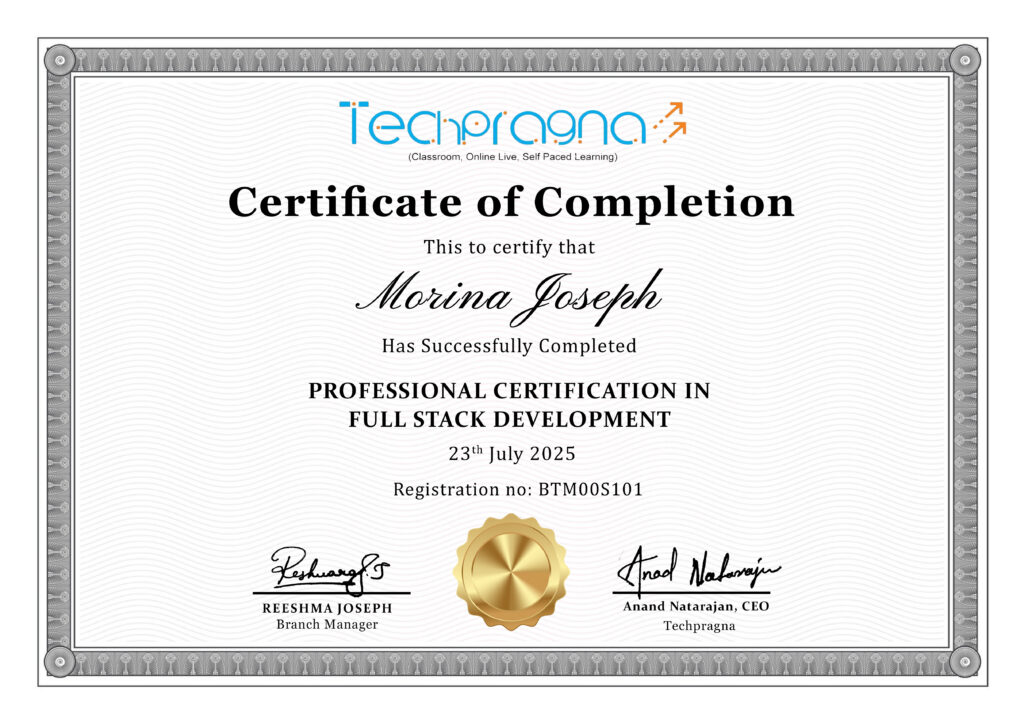
- A globally recognized certification that proves your expertise in your profile and portfolio.
- 100% placement assistance and internship via our network and expert guidance.
- Join a related community of learners in the cloud computing domain for never-ending support and reach your career goals.
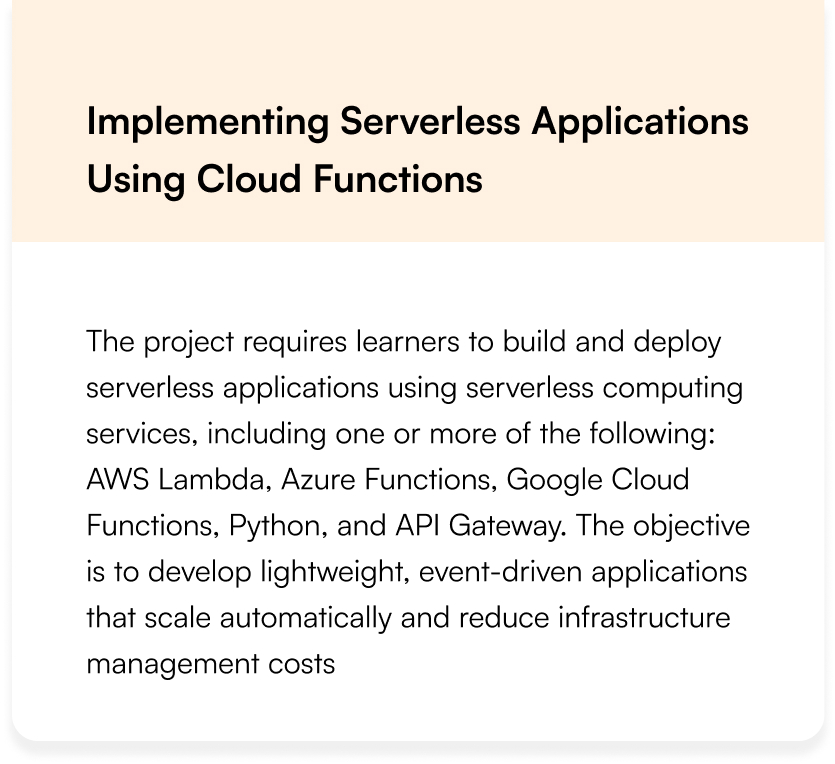
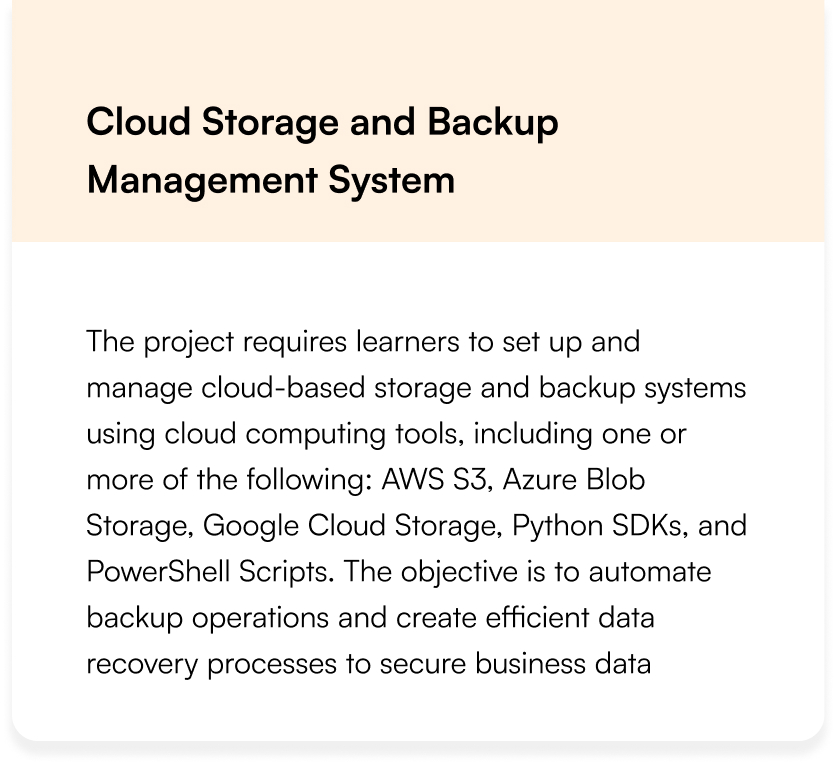
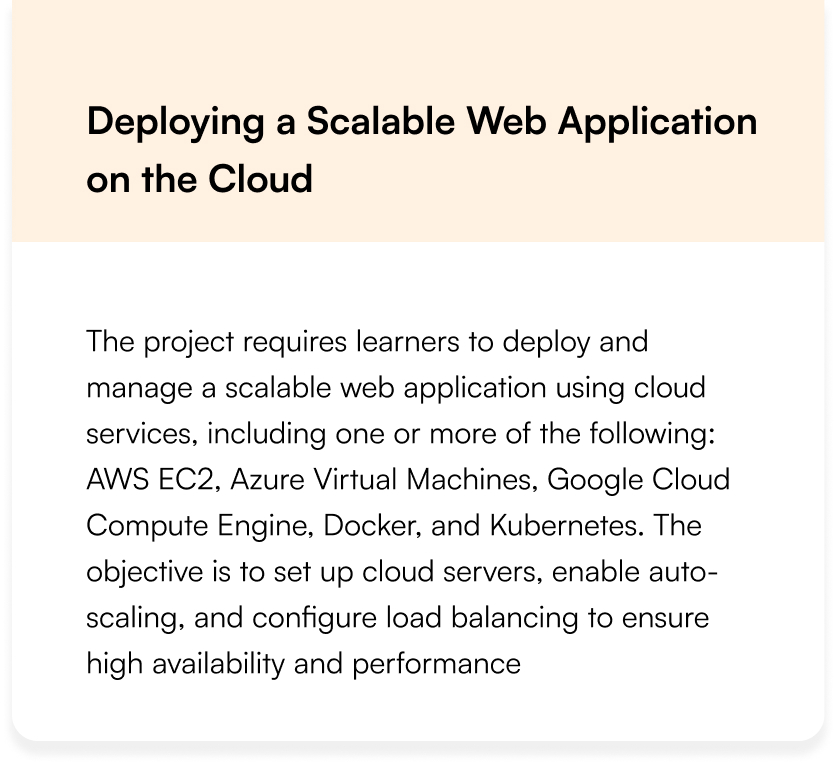
Projects that you will work on in Google Cloud Computing
Cloud Computing Projects Covered
Land Your Dream Job Our Alumni
What You’ll Learn Learn
Accelerate your career in cloud computing with our Cloud Computing Training at Tech Pragna in Bangalore. This comprehensive course equips you with the skills and techniques to design, deploy, and manage cloud infrastructure—perfect for both beginners and working professionals
Cloud Computing Training – Key Features
- AWS, Microsoft Azure, Google Cloud, Docker, Kubernetes, and Terraform
- Cloud deployment, configuration, security, virtualization, and performance optimization
- Hands-On Projects: Work on real-world cloud scenarios and practical implementations
- Understand cloud services like EC2, S3, RDS, Lambda, Load Balancers, and VPCs
- Live online and offline interactive sessions from top industry professionals
- Guaranteed placement support through our career advancement services
Request more information
Cloud Computing Course Curriculum
Module 1: Introduction to Cloud Computing
What is Cloud Computing? Evolution and Benefits
Cloud Service Models (IaaS, PaaS, SaaS, FaaS)
Deployment Models (Public, Private, Hybrid, Multi-Cloud)
Key Cloud Providers (AWS, Azure, GCP) and Their Market Share
Cloud Computing Use Cases Across Industries
Cloud Economics (CAPEX vs. OPEX, TCO)
Career Paths (Cloud Architect, DevOps Engineer, Solutions Architect)
Hands-on: Creating a Free Tier Account on AWS/Azure/GCP
Module 2: Cloud Infrastructure & Virtualization
Virtualization Basics (Hypervisors: Type 1 vs. Type 2)
Compute Resources (VMs, Containers, Serverless)
Storage Options (Block, Object, File Storage)
Networking in Cloud (VPC, Subnets, Load Balancers)
Cloud Security Fundamentals (Shared Responsibility Model)
Hands-on: Launching a VM on AWS EC2 / Azure VM
Lab: Configuring Network Security Groups (NSGs)
Case Study: Netflix’s Cloud Migration
Module 3: Cloud Storage & Databases
Cloud Storage Services (AWS S3, Azure Blob, GCP Cloud Storage)
Database Types (RDBMS vs. NoSQL vs. NewSQL)
Managed DB Services (AWS RDS, Azure SQL, GCP Cloud SQL)
Big Data Solutions (AWS Redshift, Azure Synapse, GCP BigQuery)
Data Migration Strategies (AWS DMS, Azure Data Factory)
Hands-on: Uploading Data to S3 and Setting Up an RDS Instance
Lab: Implementing a Serverless Database (AWS DynamoDB)
Disaster Recovery and Backup Solutions
Module 4: Identity & Access Management (IAM)
IAM Fundamentals (Users, Groups, Roles, Policies)
Multi-Factor Authentication (MFA)
Federated Identity (SAML, OAuth, OpenID Connect)
Privileged Access Management (PAM)
Hands-on: Configuring IAM Policies on AWS/Azure
Lab: Setting Up SSO with Azure AD / AWS SSO
Audit and Compliance (AWS CloudTrail, Azure Monitor)
Case Study: Capital One Data Breach Lessons
Module 5: Cloud Networking & Content Delivery
Virtual Private Cloud (VPC) Architecture
Cloud DNS and Load Balancing (ALB, NLB, CDN)
Hybrid Cloud Connectivity (VPN, Direct Connect, ExpressRoute)
Network Security (NACLs, Firewalls, WAF)
Hands-on: Building a Multi-Tier Architecture in AWS/Azure
Lab: Configuring a CDN (AWS CloudFront / Azure CDN)
Monitoring Network Performance (CloudWatch, Azure Network Watcher)
Case Study: How Spotify Uses Cloud Networking
Module 6: Cloud Security & Compliance
Shared Responsibility Model Deep Dive
Data Encryption (At Rest, In Transit, In Use)
Security Tools (AWS GuardDuty, Azure Security Center)
Compliance Standards (GDPR, HIPAA, SOC 2)
Hands-on: Encrypting S3 Buckets and EBS Volumes
Lab: Implementing a Cloud HSM (AWS KMS / Azure Key Vault)
Penetration Testing in Cloud (AWS Inspector, Azure Pentest)
Case Study: SolarWinds Attack and Cloud Implications
Module 7: DevOps & Cloud Automation
Infrastructure as Code (IaC) with Terraform/AWS CDK
CI/CD Pipelines (AWS CodePipeline, Azure DevOps)
Configuration Management (Ansible, Chef, Puppet)
Container Orchestration (Kubernetes vs. ECS vs. AKS)
Hands-on: Deploying Apps with Terraform
Lab: Building a CI/CD Pipeline for a Web App
Monitoring and Logging (CloudWatch, Azure Log Analytics)
Case Study: How Airbnb Uses Cloud Automation
Module 8: Serverless Computing
Serverless Architecture (AWS Lambda, Azure Functions)
Event-Driven Patterns (SQS, SNS, EventBridge)
Microservices vs. Monoliths in Cloud
Hands-on: Creating a Serverless API (API Gateway + Lambda)
Lab: Building a Chatbot with Serverless (AWS Lex)
Cost Optimization in Serverless
Debugging and Monitoring Serverless Apps
Case Study: How Coca-Cola Uses Serverless
Module 9: Cloud Migration & Hybrid Cloud
- Migration Strategies (Rehost, Refactor, Rearchitect)
- Tools (AWS Migration Hub, Azure Migrate)
- Legacy System Modernization
- Hands-on: Migrating an On-Prem VM to Cloud
- Lab: Setting Up a Hybrid Connection (AWS Outposts / Azure Stack)
- Cost Analysis and Optimization (AWS Cost Explorer, Azure Cost Mgmt)
- Case Study: Dropbox’s Cloud Exit (Lessons Learned)
- Future Trends (Edge Computing, Quantum Cloud)
Module 10: Big Data & AI in Cloud
Big Data Services (AWS EMR, Azure HDInsight)
Machine Learning in Cloud (AWS SageMaker, Azure ML)
AI Services (Rekognition, Cognitive Services)
Hands-on: Training an ML Model on Cloud
Lab: Building a Data Pipeline (AWS Glue / Azure Data Factory)
IoT and Cloud Integration (AWS IoT Core, Azure IoT Hub)
Case Study: How Tesla Uses Cloud AI
Ethics in Cloud AI
Module 11: Advanced Cloud Architectures
Multi-Cloud Strategies (Anthos, AWS Outposts)
High Availability (HA) and Fault Tolerance
Disaster Recovery (Pilot Light, Warm Standby)
Hands-on: Designing a Multi-Region Architecture
Lab: Auto-Scaling and Load Testing
Cloud-Native Design Patterns
Case Study: Netflix’s Chaos Engineering
Preparing for Cloud Certifications (AWS/Azure/GCP)
Module 12: Capstone Project & Career Prep
Real-World Cloud Project (Migration, SaaS App Deployment)
Building a Cloud Portfolio (GitHub, Blog)
Resume Tips for Cloud Roles
Mock Interviews (Scenario-Based Questions)
Certifications Roadmap (AWS/Azure/GCP)
Freelancing vs. Corporate Cloud Careers
Cloud Communities and Open Source Contributions
Final Presentation: Architecting a Cloud Solution
Career Services
Placement Assistance
Personalized Guidance
Mock Interview Preparation
One-on-One Mentoring session
Career Oriented Seesions
Resume & LinkedIn Profile Building
Land Your Dream Job Our Alumni
Cloud Computing Training FAQs
What tools will I use in cloud computing?
Answer:
Infrastructure as Code (IaC): Terraform, AWS CloudFormation.
Containers: Docker, Kubernetes.
CI/CD: Jenkins, GitHub Actions.
Monitoring: AWS CloudWatch, Azure Monitor
How do I practice cloud skills?
Answer:
Free tiers: AWS Free Tier, Azure $200 credit.
Labs: Qwiklabs, Cloud Academy.
Projects: Deploy a website, build a serverless app.
What’s the difference between DevOps and cloud computing?
Answer:
Cloud Computing: Focuses on delivering services (storage, VMs, databases).
DevOps: Uses cloud tools to automate software delivery (CI/CD, IaC)
What programming languages are useful for cloud?
Automation: Python, Bash.
Infrastructure: Terraform (HCL), YAML/JSON.
DevOps: Go, Ruby (for scripting).
Do you provide placement assistance?
Yes, many programs offer placement support, interview preparation, and resume building services
Is this course available online or offline?
Tech Pragna are offered in both online and offline
What’s the hardest part of learning cloud computing?
Complexity: Managing multi-cloud environments.
Security: Understanding shared responsibility models.
Cost control: Avoiding unexpected cloud bills.
Cloud Computing Training FAQs
What tools will I use in cloud computing?
Answer:
Infrastructure as Code (IaC): Terraform, AWS CloudFormation.
Containers: Docker, Kubernetes.
CI/CD: Jenkins, GitHub Actions.
Monitoring: AWS CloudWatch, Azure Monitor
How do I practice cloud skills?
Answer:
Free tiers: AWS Free Tier, Azure $200 credit.
Labs: Qwiklabs, Cloud Academy.
Projects: Deploy a website, build a serverless app.
What’s the difference between DevOps and cloud computing?
Answer:
Cloud Computing: Focuses on delivering services (storage, VMs, databases).
DevOps: Uses cloud tools to automate software delivery (CI/CD, IaC)
What programming languages are useful for cloud?
Automation: Python, Bash.
Infrastructure: Terraform (HCL), YAML/JSON.
DevOps: Go, Ruby (for scripting).
Do you provide placement assistance?
Yes, many programs offer placement support, interview preparation, and resume building services
Is this course available online or offline?
Tech Pragna are offered in both online and offline
What’s the hardest part of learning cloud computing?
Complexity: Managing multi-cloud environments.
Security: Understanding shared responsibility models.
Cost control: Avoiding unexpected cloud bills.
What Our Learners Have To Say
Explore the Latest Trending Courses

Software Testing
- Online/Offline
- 6 Months
- Professional Level Certification
- Projects and Case Study
Data Science
- Online/Offline
- 6 Months
- Professional Level Certification
- Projects and Case Study

Network Engineering
- Online/Offline
- 6 Months
- Professional Level Certification
- Projects and Case Study

Cyber Security
- Online/Offline
- 6 Months
- Professional Level Certification
- Projects and Case Study