Best Python Programming Course
- Enhance your professional profile with relevant industry projects.
- Adept in commonly preferred Python frameworks and libraries – Django, Pandas, Flask, etc.
- 100% guaranteed placement through Accelerated Career Services.




Machine Learning in Python
Be an expert in building innovative applications with Techpragna’s machine learning in Python before you enter as an employee! Our course makes you industry-ready with hands-on projects where you learn the practical skills required for predictive models and automated decision-making to solve real-world business problems.
Salient Features - Python programming and Machine learning
- A blend of skills and hands-on project experience in PyCharm, VS Code, and more.
- In-and-out know-how of data types, control structures, functions, and OOP concepts.
- Training, Tips, and Tricks from expert faculty with industry experience.
- Master essenti Scope to work on real-time coding and problem-solving skills under expert guidance.al tools: Excel, SQL, Python, Power BI, Tableau, and Statistics
- Participatory workshops and bootcamps for Python
- Expertise in testing and debugging with the help of tools such as Pytest and Built-in debugging.
Accelerate your career in data with our Data Analytics Training at TechPragna in Bangalore. This comprehensive course equips you with the tools and techniques to collect, analyze, and visualize data for actionable business insights—perfect for both beginners and working professionals.
- Master essential tools: Excel, SQL, Python, Power BI, Tableau, and Statistics
- Live online and offline interactive sessions from top industry professionals
- Guaranteed placement support through our career advancement services
- Master essential tools: Excel, SQL, Python, Power BI, Tableau, and Statistics
- Live online and offline interactive sessions from top industry professionals
- Guaranteed placement support through our career advancement services
Computer language Python Curriculum
Module 1: Introduction to Python and Environment Setup
- What is Python? History, features, and use cases
- Installing Python (3.x) and setting up the environment
- Understanding Python interpreter and execution flow
- IDE setup: VS Code / PyCharm configuration
- Running Python programs using CLI and IDE
- Mini Task: Write a simple Python script and execute it
Module 2: Python Syntax and Basics
- Python syntax rules and indentation
- Variables and naming conventions
- Comments and documentation strings
- Keywords and identifiers
- Input and output operations
- Mini Task: Build a basic calculator program
Module 3: Data Types and Type Casting
- Numbers, strings, booleans
- Type checking and type conversion
- Mutable vs immutable data types
- Built-in functions for data types
- Mini Task: Data type-based utility program
Module 4: Operators and Expressions
- Arithmetic, relational, and logical operators
- Assignment and bitwise operators
- Operator precedence
- Expression evaluation
- Mini Task: Mathematical operations script
Module 5: Control Flow Statements
- Conditional statements (if, elif, else)
- Nested conditions
- Match-case (Python 3.10+)
- Mini Task: Decision-based application
Module 6: Loops and Iteration
- for loop and while loop
- break, continue, and pass
- Nested loops
- Loop optimization techniques
- Mini Task: Pattern printing and number series
Module 7: Strings and String Manipulation
- String methods and operations
- Indexing and slicing
- Formatting techniques
- Regular expressions basics
- Mini Task: Text processing program
Module 8: Lists, Tuples, and Sets
- List operations and methods
- Tuple characteristics and use cases
- Set operations and applications
- Comprehensions
- Mini Task: Data collection manager
Module 9: Dictionaries and Advanced Collections
- Dictionary creation and methods
- Nested dictionaries
- Collections module overview
- Mini Task: Key-value data handling system
Module 10: Functions and Modules
- Defining and calling functions
- Arguments and return values
- Lambda functions
- Creating and importing modules
- Mini Task: Utility-based Python module
- Generator and Decorator
Module 11: Object-Oriented Programming (OOP)
- Classes and objects
- Constructors and methods
- Inheritance and polymorphism
- Encapsulation and abstraction
- Mini Task: OOP-based mini project
Module 12: Exception Handling and Debugging
- Types of errors and exceptions
- try, except, else, finally
- Custom exceptions
- Debugging techniques
- Mini Task: Fault-tolerant application
Module 13: File Handling and OS Operations
- Reading and writing files
- Working with CSV and text files
- OS and sys modules
- Directory and file management
- Mini Task: File management tool
Module 14: Python Libraries and Virtual Environments
- pip and package management
- Virtual environments (venv)
- Popular libraries overview (NumPy, Pandas, Requests)
- Mini Task: Library-based application
Module 15: Testing, Automation, and Scripting
- Unit testing with unittest / pytest
- Automation basics with Python
- Writing reusable scripts
- Mini Task: Automation script project
Module 16: Project, Git, and Deployment Basics
- Git and GitHub fundamentals
- Project structuring best practices
- Basic deployment concepts
- Final Project: Real-world Python application
- Portfolio and interview preparation
Module 1: Web Fundamentals & Frontend Basics
How the Web Works (HTTP/HTTPS, DNS, APIs)
HTML5 & Semantic Web Structure
CSS3 (Flexbox, Grid, Animations)
JavaScript (ES6+) Fundamentals
DOM Manipulation & Events
Responsive Design (Media Queries, Mobile-First)
Developer Tools (Chrome DevTools, VS Code)
Project: Build a Portfolio Website
Module 2: Advanced Frontend with React
React Fundamentals (Components, State, Props)
Hooks (useState, useEffect, useContext)
React Router for SPA Navigation
State Management (Redux/Toolkit)
API Integration (Axios, Fetch)
Styling (Styled-Components, Tailwind CSS)
Testing (Jest, React Testing Library)
Project: E-Commerce Frontend
Module 3: Backend Development with Node.js
Node.js & Express.js Setup
RESTful API Design (CRUD Operations)
Middleware (Authentication, Error Handling)
File Uploads (Multer, Cloud Storage)
WebSockets (Real-Time Apps with Socket.io)
API Documentation (Swagger/OpenAPI)
Unit Testing (Mocha, Chai)
Project: Bookstore API
Module 4: Databases & ORMs
SQL vs. NoSQL (PostgreSQL vs. MongoDB)
Database Design (Relationships, Indexing)
Querying with SQL (Joins, Subqueries)
MongoDB Aggregation & Atlas
ORMs (Sequelize, Mongoose)
Caching (Redis)
Database Security (SQL Injection, NoSQL Injection)
Project: User Auth System with DB
Module 5: Python Backend (Django/Flask)
Python Refresher (OOP, Decorators)
Django (Models, Views, Templates)
Django REST Framework (Serializers, Auth)
Flask (Routing, Blueprints)
FastAPI (Async, Pydantic)
PostgreSQL Integration (Psycopg2)
Project: Blog API (Django + React)
Module 6: DevOps & Deployment
Git & GitHub (Branching, Pull Requests)
CI/CD Pipelines (GitHub Actions, Jenkins)
Docker (Containers, Docker Compose)
Cloud Deployment (AWS EC2, Heroku, Vercel)
Nginx & Load Balancing
Monitoring (Prometheus, Grafana)
Project: Deploy a Full Stack App
Module 7: Advanced JavaScript (TypeScript, Next.js)
TypeScript (Interfaces, Generics)
Next.js (SSR, SSG, ISR)
GraphQL (Apollo Server, Client)
Web Performance Optimization
Progressive Web Apps (PWAs)
Project: Next.js Social Media App
Module 8: Microservices & Scalability
- Monolith vs. Microservices
- API Gateways (Kong, AWS API Gateway)
- Message Brokers (RabbitMQ, Kafka)
- Container Orchestration (Kubernetes)
- Project: Scalable Chat App
Module 9: Testing & QA
Unit vs. Integration vs. E2E Testing
Jest (Frontend Testing)
Postman (API Testing)
Selenium (Automated UI Testing)
Project: Test Suite for an App
Module 10: Security Best Practices
OAuth 2.0 & JWT
HTTPS & SSL/TLS
CORS & CSRF Protection
Rate Limiting & DDoS Prevention
Project: Secure Payment Gateway
Module 11: Agile & Collaboration
Scrum & Kanban
Jira & Trello
Code Reviews
Project: Team-Based App Development
Module 12: Capstone Project & Career Prep
Final Project: Full Stack SaaS Application
Resume & LinkedIn Optimization
Mock Interviews (Technical & Behavioral)
Freelancing vs. Full-Time Roles
Career Scope in Python Programming and Machine Learning
A certified Python Programming and Machine Learning professional prioritizes writing clean, efficient, and scalable code on every platform and operating system, besides solving real-world technical problems. They work on large-scale projects related to automation, data processing, front- and back-end development, and scripting, including performance maintenance.
Python Developer
Besides structuring a website with look and feel, a Python Developer develops application logic, back-end services, and APIs leveraging data structures.
Automation QA Engineer
Builds formidable automation frameworks and tests their functionality leveraging tools such as Selenium, Pytest, and Robot Framework.
.
Data Engineer/Analyst
Analyses, monitors, processes, and cleanses large datasets using advanced tools.
Backend Developer
Focuses on developing server-side applications in the Python Programming Language with its frameworks. Django and Flask are the well-known frameworks used for database integration.
Automation Engineer
Writes programming scripts exclusively for system administration, automating tasks, file processing, and deployment workflows.
Machine Learning Engineer
Primarily creates and delivers predictive models that help in accurate decision-making.
Scripting & Tooling Specialist
Focuses on creating command-line tools, utilities, and internal tools required for organizational efficiency and enhanced productivity.
Algorithm Engineer
Uses efficient algorithms and strong logical skills to solve complex computational problems for improving organizational performance and system efficiency.
Skills Covered in Python Course
Object-Oriented Programming (OOP) in Python
Python Syntax and Data Types
Exception Handling and Error Management
Built-in Collections (List, Tuple, Set, Dictionary)
Multithreading and Concurrency Basics
Functional Programming Concepts (Lambda, Map, Filter)
File Handling and Directory Operations
String Manipulation and Text Processing
Modules, Packages, and Virtual Environments
Memory Management and Garbage Collection in Python
Tools Covered: Machine Learning in Python

Frontend Developer
Designs and builds interactive user interfaces using HTML, CSS, and JavaScript frameworks (React, Angular, Vue) to create seamless web experiences
Backend Developer
Develops server-side logic, APIs, and databases to ensure data processing, storage, and security for web applications
.
Full Stack Developer
Combines frontend and backend expertise to build end-to-end web applications, ensuring smooth integration between UI and server logic.
DevOps Engineer
Automates deployment, monitors performance, and manages cloud infrastructure to ensure scalable and reliable application delivery
UI/UX Developer
Focuses on user experience design, implementing responsive layouts and accessibility standards while collaborating with designers
Solutions Architect
Designs high-level web application structures, selects optimal tech stacks, and ensures systems meet business and technical requirements.
Skills Covered
Frontend
Backend
Databases
APIs
DevOps
Testing
Security
Git, VS Code, Postman
Problem-Solving
AWS
12+ Data Science Tools Covered

Accelerating Career Services in Python Programming Language


Guidance for clearing interview rounds

Customized and Individual Guidance

Rigorous training for interview preparation

Individual Mentoring Session

Student and Career-Centric Sessions

Guide to build a curriculum vitae.
Career Services
Placement Assistance
Personalized Guidance
Mock Interview Preparation
One-on-One Mentoring session
Career Oriented Seesions
Resume & LinkedIn Profile Building
How our program works
Enhance Your Skills to Transform Your Career Path
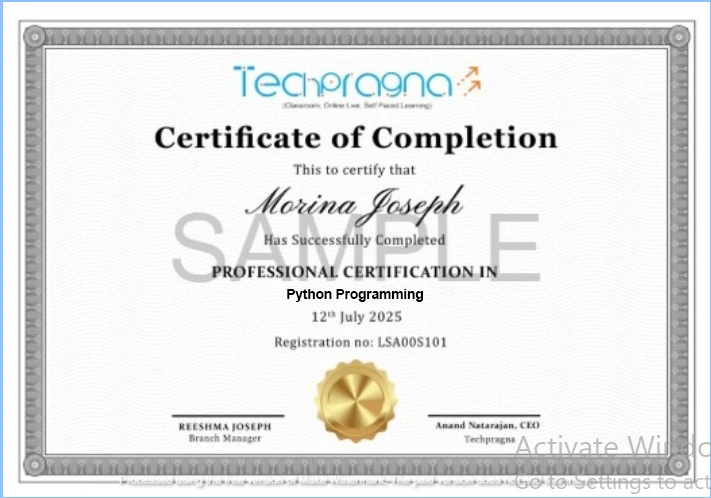
- Acquire an industry-recognized Python programming machine learning certificate that proves your skills and credibility to prospective employers and clients.
- Get noticed by your employers and clients with your dexterity in Python, data analysis, AI, & ML technologies.
- Develop Python Programming skills relevant to industry with 100% practical projects.
- Build innovative applications in Python, ML algorithms, and other libraries.
- · Expert mentorship, career guidance, and training to face technical interviews with confidence.
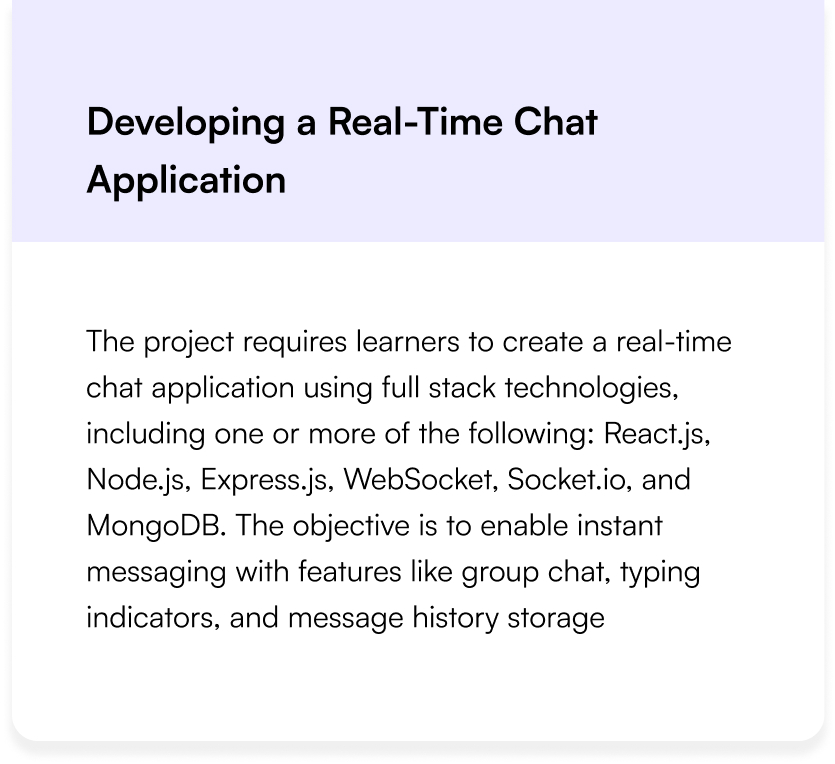
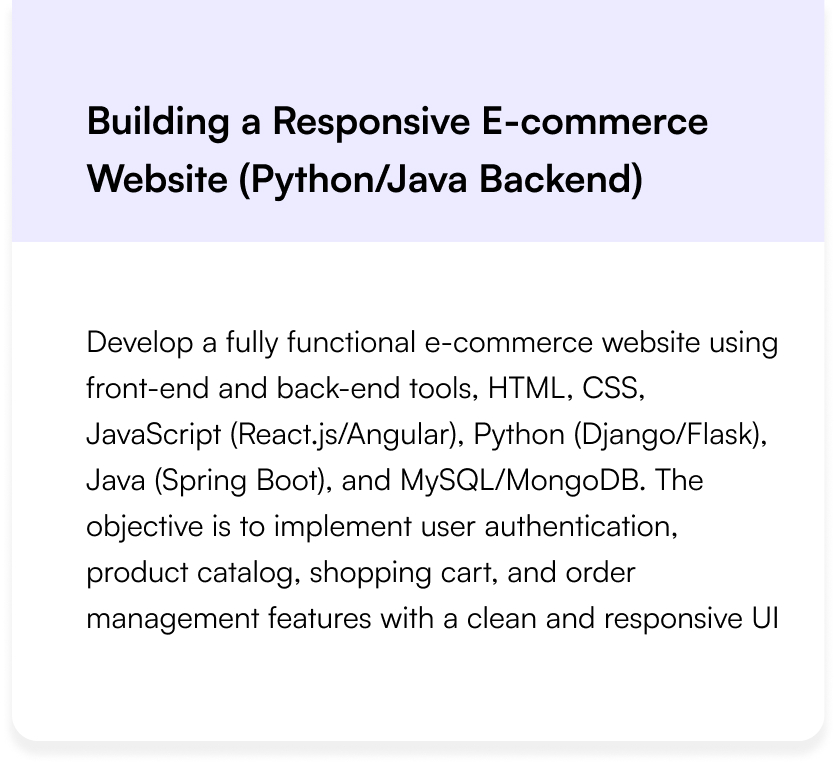
Projects Covered
Data Analytics Projects Covered
Land Your Dream Job Our Alumni
Full Stack Development Training FAQs
What is full stack development?
Answer: Full stack development involves building both the frontend (user interface) and backend (server, database) of web applications, covering all layers of software development
What technologies will I learn?
Answer:
Frontend: HTML/CSS, JavaScript, React/Angular
Backend: Node.js, Python (Django/Flask), or Java (Spring Boot)
Databases: SQL (PostgreSQL), NoSQL (MongoDB)
DevOps: Docker, AWS, CI/CD
Will I get a certificate after completion?
Yes, the course is designed for beginners from any educational or professional background.
What’s the difference between frontend and backend?
Answer:
Frontend: What users see (UI, animations, forms).
Backend: Server logic, databases, APIs (hidden from users)
Is Python or Node.js better for backend?
Answer:
Node.js: Faster for real-time apps (chat, streaming).
Python (Django/Flask): Better for data-heavy apps (AI, analytics)
Is this course available online or offline?
Tech Pragna are offered in both online and offline
How do I practice full stack skills?
Answer:
Code daily: FreeCodeCamp, LeetCode.
Clone apps: Build a Netflix/Twitter clone.
Contribute to open-source
What Our Learners Have To Say
Explore the Latest Trending Courses
Explore the Latest Trending Courses
Software Testing
- Online/Offline
- 6 Months
- Professional Level Certification
- Projects and Case Study
Data Science
- Online/Offline
- 6 Months
- Professional Level Certification
- Projects and Case Study

Network Engineering
- Online/Offline
- 6 Months
- Professional Level Certification
- Projects and Case Study

Cyber Security
- Online/Offline
- 6 Months
- Professional Level Certification
- Projects and Case Study