Java Programming
- JAVA with HTML, CSS, JavaScript, MongoDB, Node.js, and React.js
- Practical and Interactive Learning from Industry Experts anytime, anywhere.
- Way to Employment and Bright Future.
- Mastery in building complete web solutions.




Java Programming Certification Course
Increase your employability chances with our Java Programming Certification Course at Techpragna in Bangalore. Master Core Java, Advanced Java Programming, OOPS programming concepts, JDBC with all web technologies, JSP, Hibernate, and Spring required for application development through live projects that make you future-ready. Open to beginners and professionals seeking a career as a Java Developer.
Java Programming Course – Key Features
- Training from industry experts
- Proficiency in developing standalone, multithreaded, and high-performance apps.
- Be a certified Java developer within 3 months.
- Fast-track your Java developer career in 3 months.
- Gain Java skills and certification in 3 months.
- Learn, in just 3 months.
- Participatory workshops designed for online and offline training.
- Blended learning experience of programming theory and applied learning with live projects.
- Expertise in top developer tools such as Eclipse IDE, IntelliJ, VS Code, Maven, etc.
- Transform your Java skills into a career in 3 months.
Accelerate your career in data with our Data Analytics Training at TechPragna in Bangalore. This comprehensive course equips you with the tools and techniques to collect, analyze, and visualize data for actionable business insights—perfect for both beginners and working professionals.
- Master essential tools: Excel, SQL, Python, Power BI, Tableau, and Statistics
- Live online and offline interactive sessions from top industry professionals
- Guaranteed placement support through our career advancement services
- Master essential tools: Excel, SQL, Python, Power BI, Tableau, and Statistics
- Live online and offline interactive sessions from top industry professionals
- Guaranteed placement support through our career advancement services
Full Stack Development Curriculum
Module 1: Introduction to Java and Environment Setup
• What is Java? History, features, and platform independence.
• Deconstructing the JVM (Java Virtual Machine), JRE (Java Runtime Environment), and
JDK (Java Development Kit).
• Setup of Development Environment: Installing JDK 21+ and configuring IntelliJ
IDEA/Eclipse paths.
• Execution Workflow: Writing, compiling (javac), and running (java) programs via
command line and IDE.
• Structure of a Java Class: Package declarations, main method, and syntax
fundamentals.
• Mini Task: Write a CLI system information utility tool.
Module 2: Language Fundamentals and Data Types
• Primitive Data Types: Numeric, floating-point, character, and boolean types.
• Variables, Constants (final keyword), and Scope of Variables.
• Type Conversion: Implicit widening vs. explicit narrowing type casting.
• Operators in Java: Arithmetic, relational, logical, bitwise, assignment, and ternary
operators.
• Console Input/Output: Working with Scanner and System.out formatting.
• Hands-On: Build a comprehensive terminal-based scientific calculator.
Module 3: Control Flow Statements
• Conditional Logic: If, if-else, nested-if, and switch-case (including modern switch
expressions).
• Iteration Structures: For loops, while loops, do-while loops, and the enhanced foreach loop.
• Loop Control: Using break, continue, and labeled statements.
• Algorithmic Logic: Implementing prime checks, Fibonacci series, and GCD
calculations.
• Hands-On: Code a text-based interactive number guessing game with limited
attempts.
Module 4: Array Manipulations and Matrices
• Single-Dimensional Arrays: Declaration, allocation, initialization, and element access.
• Memory layout of arrays in Java.
• Multi-Dimensional Arrays: Working with matrices and jagged arrays.
• Common Array Operations: Searching (Linear/Binary) and Basic Sorting
(Bubble/Insertion).
• Using the java.util.Arrays helper class for cloning, filling, and sorting.
• Lab: Implement a console-based matrix multiplication and rotation tool.
Module 5: String Handling and Regular Expressions
• The String Class: Understanding the String Constant Pool and immutability.
• String Manipulation: Core methods for searching, splitting, replacing, and trimming
text.
• Performance Optimization: Using StringBuilder and StringBuffer for mutable
operations.
• Regular Expressions: Pattern matching and input validation using Pattern and
Matcher classes.
• Lab: Create an advanced text file content parser and data validator.
Module 6: Principles of Object-Oriented Programming (OOP)
• Classes and Objects: Defining states (fields) and behaviors (methods).
• Understanding Reference Variables and Object Lifecycle.
• Packages and Access Modifiers: Public, private, protected, and package-private
(default).
• Constructors: Default, parameterized, and constructor overloading using this().
• Static Keyword: Static variables, static methods, and static initialization blocks.
• Hands-On: Model an inventory system using pure class relations.
Module 7: Pillars of OOP: Inheritance and Polymorphism
• Inheritance: Extending classes, super keyword, and single vs. multi-level hierarchies.
• Method Overriding vs. Method Overloading: Runtime vs. compile-time
polymorphism.
• Object Type Casting: Upcasting, downcasting, and using the instanceof operator.
• Understanding Object class methods: toString(), equals(), and hashCode().
• Task: Design a core paycheck engine with varied employee types.
Module 8: Abstraction: Interfaces and Abstract Classes
• Abstract Classes: Defining abstract methods, concrete methods, and instance
variables.
• Interfaces: Defining contracts, constant fields, abstract methods, and default/static
methods.
• Multiple Inheritance implementation via interfaces.
• Functional Interfaces: Abstract method limits and basic structure.
• Tagging/Marker Interfaces: Understanding Cloneable and Serializable.
• Hands-On: Build a decoupled payment processing engine layout using interfaces.
Module 9: Memory Management and Garbage Collection
• Java Memory Model: Understanding Heap memory vs. Stack memory allocation.
• Object Creation and reference tracking mechanics.
• Garbage Collection: How the JVM reclaims memory automatically.
• Methods for garbage collection: System.gc() and finalize() lifecycle.
• Memory Leaks in Java: Identifying dangling references and unclosed resources.
• Task: Profile local applications to track object allocations.
Module 10: Exception Handling Hierarchy
• Errors vs. Exceptions: Understanding Throwable, Error, Exception, and
RuntimeException.
• Handling Blocks: Using try, catch, and finally blocks effectively.
• Propagating Exceptions: Using throw and throws keywords.
• Try-with-resources: AutoCloseable interface for safe stream management.
• Creating Custom Exceptions to model unique business validation rule failures.
• Lab: Write a strict terminal bank transaction file parser with robust error traps.
Module 11: Java Collections Framework: Lists and Sets
• Collections Architecture: The core interfaces and implementation layouts.
• Working with Lists: ArrayList vs. LinkedList performance and vector mechanics.
• Working with Sets: HashSet, LinkedHashSet (insertion order), and TreeSet (sorted
layout).
• Iterating Collections: Using Iterator, ListIterator, and For-Each method.
• Lab: Build a console student records manager using list collections.
Module 12: Advanced Collections: Maps and Sorting
• Map Architecture: Key-value pair tracking via HashMap, LinkedHashMap, and
TreeMap.
• Internal working of HashMap: Buckets, hashing, collisions, and equals/hashCode
contracts.
• Sorting Object Collections: Implementing the Comparable interface vs. custom
Comparator objects.
• Legacy Utilities: Working with Properties, Hashtable, and Enumerations.
• Task: Build an analytics report showing item frequencies from a text dataset.
Module 13: Java I/O Streams and File Operations
• Byte Streams: Working with FileInputStream, FileOutputStream,
BufferedInputStream, and BufferedOutputStream.
• Character Streams: Working with FileReader, FileWriter, BufferedReader, and
BufferedWriter.
• Data Serialization: Writing and reading stateful Java objects using
ObjectOutputStream.
• Java NIO (New I/O): File navigation, path operations, and fast channel buffers.
• Lab: Build a data serialization engine to backup and restore system application
settings.
Module 14: Multi-threading Foundations
• Processes vs. Threads: Understanding concurrency within a single JVM.
• Thread Creation: Extending the Thread class vs. implementing the Runnable
interface.
• Thread Lifecycle: New, Runnable, Blocked, Waiting, Timed_Waiting, and Terminated
states.
• Managing Threads: Sleep, join, yield, and interrupt methods.
• Daemon Threads: Background task workers and configuration options.
• Hands-On: Code a console countdown timer executing parallel tracking loops.
Module 15: Thread Synchronization and Concurrency Utilities
• Concurrency Pitfalls: Race conditions, data corruption, and critical section problems.
• Synchronization: Using synchronized methods and synchronized code blocks.
• Inter-Thread Communication: Using wait(), notify(), and notifyAll() patterns safely.
• Thread Safety: Volatile keyword, atomic variables, and explicit Lock objects.
• Executor Framework: ThreadPoolExecutor, ScheduledExecutorService, and
Callable/Future tasks.
• Lab: Build a multi-threaded producer-consumer simulation for processing local log
files.
Module 16: Java 8+ Evolution: Lambdas, Streams, and Capstone
• Lambda Expressions: Syntax syntax, variable capture, and writing inline function
bodies.
• Stream API Basics: Processing collections via filter(), map(), sorted(), and collect()
pipelines.
• The Optional Class: Eliminating NullPointerExceptions cleanly.
• Java Date and Time API (java.time): Handling local dates, times, durations, and
periods.
• Capstone Project: End-to-end design, implementation, and unit testing (JUnit 5) of a
multi-threaded console utility app.
Module 1: Web Fundamentals & Frontend Basics
How the Web Works (HTTP/HTTPS, DNS, APIs)
HTML5 & Semantic Web Structure
CSS3 (Flexbox, Grid, Animations)
JavaScript (ES6+) Fundamentals
DOM Manipulation & Events
Responsive Design (Media Queries, Mobile-First)
Developer Tools (Chrome DevTools, VS Code)
Project: Build a Portfolio Website
Module 2: Advanced Frontend with React
React Fundamentals (Components, State, Props)
Hooks (useState, useEffect, useContext)
React Router for SPA Navigation
State Management (Redux/Toolkit)
API Integration (Axios, Fetch)
Styling (Styled-Components, Tailwind CSS)
Testing (Jest, React Testing Library)
Project: E-Commerce Frontend
Module 3: Backend Development with Node.js
Node.js & Express.js Setup
RESTful API Design (CRUD Operations)
Middleware (Authentication, Error Handling)
File Uploads (Multer, Cloud Storage)
WebSockets (Real-Time Apps with Socket.io)
API Documentation (Swagger/OpenAPI)
Unit Testing (Mocha, Chai)
Project: Bookstore API
Module 4: Databases & ORMs
SQL vs. NoSQL (PostgreSQL vs. MongoDB)
Database Design (Relationships, Indexing)
Querying with SQL (Joins, Subqueries)
MongoDB Aggregation & Atlas
ORMs (Sequelize, Mongoose)
Caching (Redis)
Database Security (SQL Injection, NoSQL Injection)
Project: User Auth System with DB
Module 5: Python Backend (Django/Flask)
Python Refresher (OOP, Decorators)
Django (Models, Views, Templates)
Django REST Framework (Serializers, Auth)
Flask (Routing, Blueprints)
FastAPI (Async, Pydantic)
PostgreSQL Integration (Psycopg2)
Project: Blog API (Django + React)
Module 6: DevOps & Deployment
Git & GitHub (Branching, Pull Requests)
CI/CD Pipelines (GitHub Actions, Jenkins)
Docker (Containers, Docker Compose)
Cloud Deployment (AWS EC2, Heroku, Vercel)
Nginx & Load Balancing
Monitoring (Prometheus, Grafana)
Project: Deploy a Full Stack App
Module 7: Advanced JavaScript (TypeScript, Next.js)
TypeScript (Interfaces, Generics)
Next.js (SSR, SSG, ISR)
GraphQL (Apollo Server, Client)
Web Performance Optimization
Progressive Web Apps (PWAs)
Project: Next.js Social Media App
Module 8: Microservices & Scalability
- Monolith vs. Microservices
- API Gateways (Kong, AWS API Gateway)
- Message Brokers (RabbitMQ, Kafka)
- Container Orchestration (Kubernetes)
- Project: Scalable Chat App
Module 9: Testing & QA
Unit vs. Integration vs. E2E Testing
Jest (Frontend Testing)
Postman (API Testing)
Selenium (Automated UI Testing)
Project: Test Suite for an App
Module 10: Security Best Practices
OAuth 2.0 & JWT
HTTPS & SSL/TLS
CORS & CSRF Protection
Rate Limiting & DDoS Prevention
Project: Secure Payment Gateway
Module 11: Agile & Collaboration
Scrum & Kanban
Jira & Trello
Code Reviews
Project: Team-Based App Development
Module 12: Capstone Project & Career Prep
Final Project: Full Stack SaaS Application
Resume & LinkedIn Optimization
Mock Interviews (Technical & Behavioral)
Freelancing vs. Full-Time Roles
Java Certification Course - Career Path
Techpragna’s Java Certification Course opens a multitude of career paths that take you to great heights.
Junior Java Developer
The role of a Java Developer at the Junior Level is to design, develop, and maintain the software’s quality, including debugging, under the supervision of their superiors.
Android Developer
They use Java to develop Android apps and user interfaces, implement app functionality, handle API integration, and manage lifecycle components, creating a fully functional app in line with Google’s guidelines.
Java Full Stack Developer
Works with front-end technologies such as HTML, CSS, and JavaScript. Also, they work on back-end technologies using Java, developing end-to-end web apps, designing and implementing, and managing databases.
Senior Java Developer
Writes and reviews Java code and improves the complexity level of the projects, resolving technical issues. Also, they work independently on complex modules, review the code, and ensure it meets the client requirements.
UI/UX Developer
Specializes as a software developer and concentrates on creating user interfaces and user experiences for digital products. They also translate design concepts into functional, responsive front-end code.
Technical Head
Leads the development team and provides them with technical guidance. They also assign tasks to developers and mentor them, thereby overseeing project execution. The technical head further coordinates with developers, explaining the architectures, coding standards, and best practices.
Skills Covered
Frontend
Backend
Databases
APIs
DevOps
Testing
Security
Git, VS Code, Postman
Problem-Solving
AWS
Tools Covered in Java Programming Language

Frontend Developer
Designs and builds interactive user interfaces using HTML, CSS, and JavaScript frameworks (React, Angular, Vue) to create seamless web experiences
Backend Developer
Develops server-side logic, APIs, and databases to ensure data processing, storage, and security for web applications
.
Full Stack Developer
Combines frontend and backend expertise to build end-to-end web applications, ensuring smooth integration between UI and server logic.
DevOps Engineer
Automates deployment, monitors performance, and manages cloud infrastructure to ensure scalable and reliable application delivery
UI/UX Developer
Focuses on user experience design, implementing responsive layouts and accessibility standards while collaborating with designers
Solutions Architect
Designs high-level web application structures, selects optimal tech stacks, and ensures systems meet business and technical requirements.
Skills Covered
Frontend
Backend
Databases
APIs
DevOps
Testing
Security
Git, VS Code, Postman
Problem-Solving
AWS
12+ Data Science Tools Covered

Career Services


Employment & Future-Ready Support

Tailored Career Consultation & Guidance

Individual Mentoring

Workshops on Career Growth

Professional Optimization of Profiles

Dedicated & Interactive Interview Preparation
Career Services
Placement Assistance
Personalized Guidance
Mock Interview Preparation
One-on-One Mentoring session
Career Oriented Seesions
Resume & LinkedIn Profile Building
How our program works
Enhance Your Skills to Transform Your Career Path
- Earn recognized validation of your knowledge from a reputable institution, boosting your credibility with employers and clients.
- Differentiate yourself in today's competitive job market and open doors to better job opportunities, career advancement, or freelance projects.
- Certifications align your skills with the latest industry standards, ensuring you're ready to contribute effectively from day one.
- Certifications validate your expertise and prepare you to meet current workplace demands from day one.
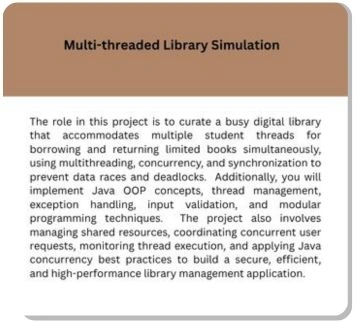
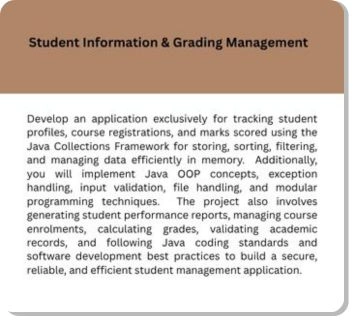
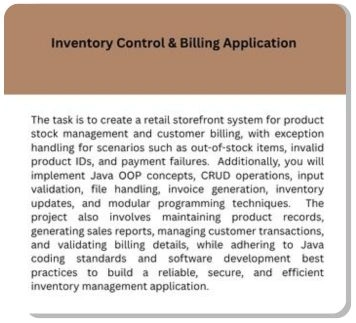
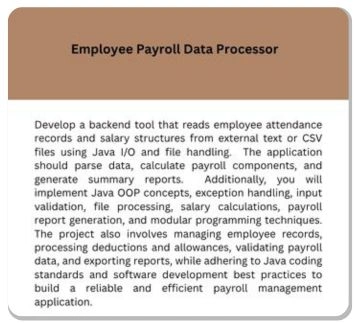
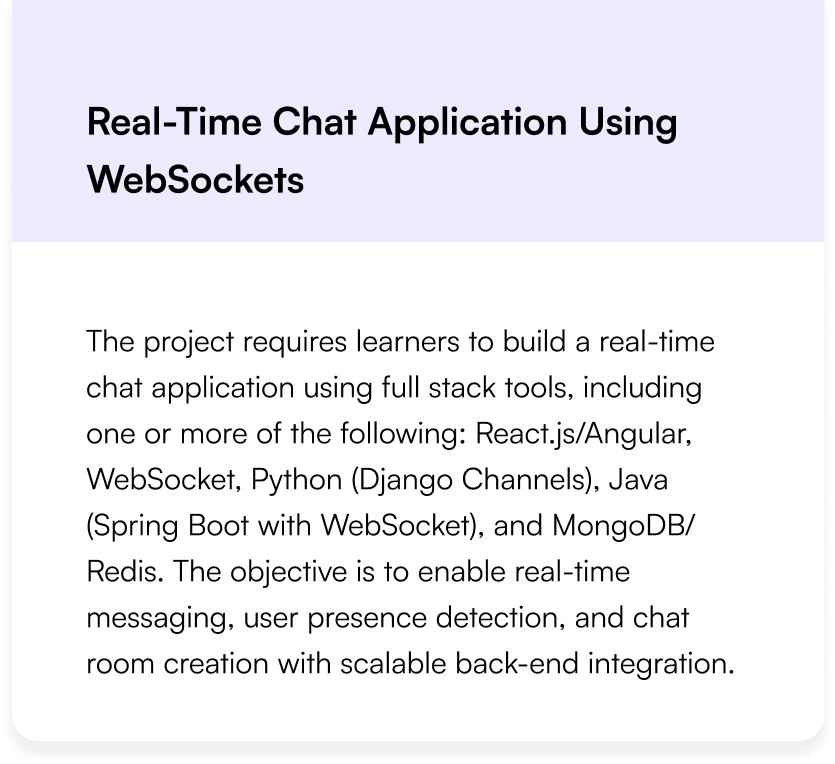
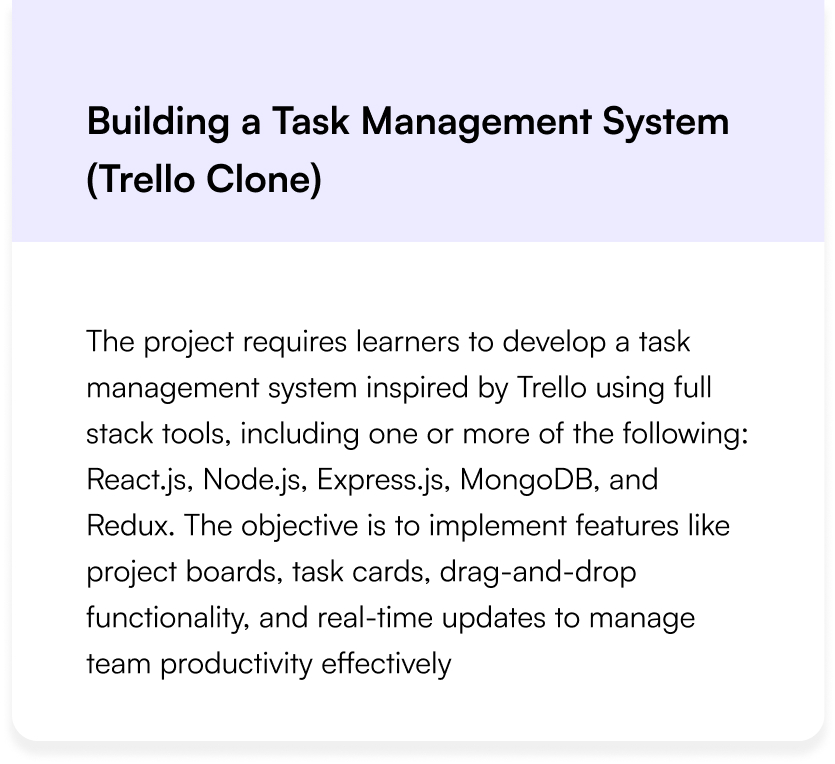
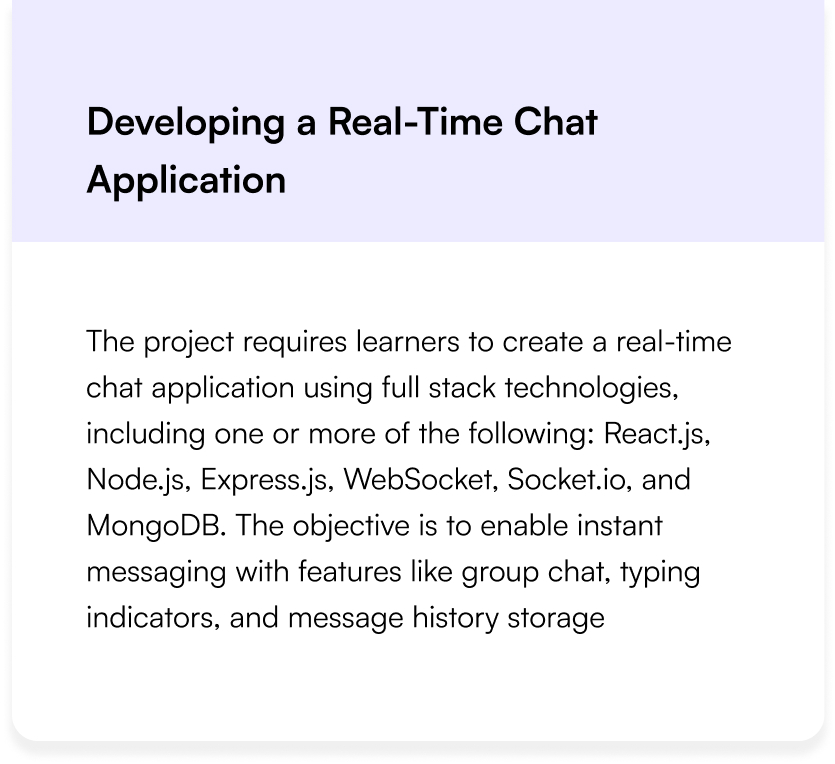
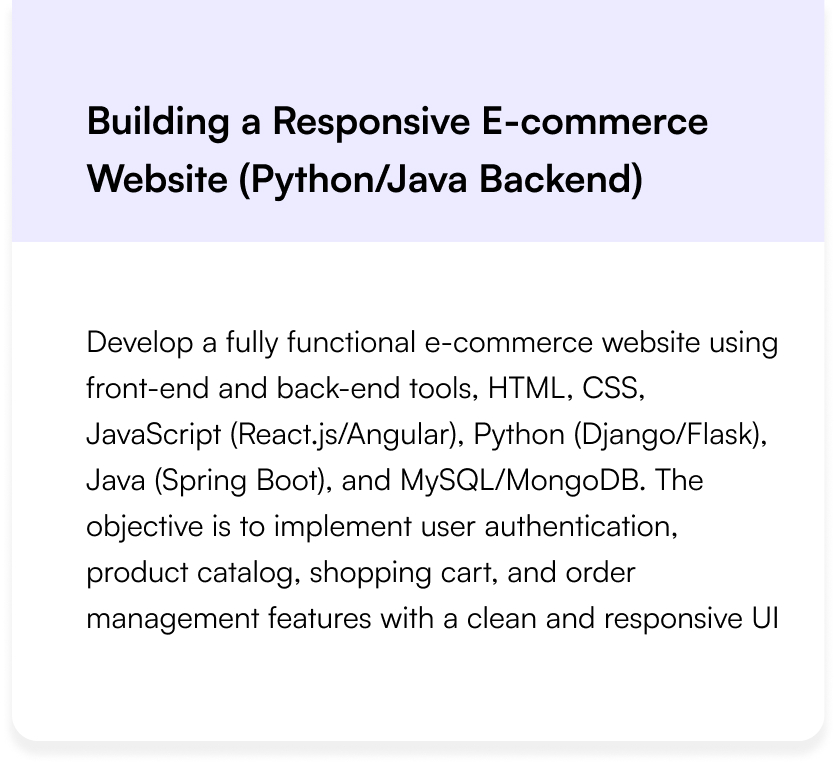
Java Full-Stack Projects Covered
Data Analytics Projects Covered
Land Your Dream Job Our Alumni
Java Full-Stack Development Training – FAQs
What makes the Java Full-Stack Course a popular choice?
Answer:
The Java Full-Stack Development Course is a blend of frontend coding, backend coding, and database technologies that enables developers to build full-fledged applications. Therefore, it has become preferred by many companies.
What do you mean by instructor-led online training?
Answer:
An instructor-led online training is a virtual mode of training where students log on at the specified timings for live sessions and engage in online interaction with the trainer.
If I enroll in the Java Programming Course, how many batches can I attend?
Techpragna provides an integrated and blended learning mode where you can attend both online and classroom training at your convenience. Furthermore, the trainer will also send you the video recordings for download.
Is Java full-stack open source?
Answer:
Though Java Full-Stack is based on open-source technologies, it isn’t an independent open-source product. It’s a technology stack designed to develop a complete web application.
Can a non-engineering graduate learn Java?
Answer:
Of course, yes. Java Programming is open to all graduates from different educational backgrounds.
Are there equal job opportunities for all graduates?
Not always. The selection criteria depend on the company requirements. However, that’s not the end of the world. If you aren’t an engineering graduate or a computer graduate, you can begin your career either in startups, small/medium-sized IT companies, software consulting firms, or companies that will look more at skills than a degree. Once you get valuable experience, getting into an MNC would be easier.
Full Stack Development Training FAQs
What is full stack development?
Answer: Full stack development involves building both the frontend (user interface) and backend (server, database) of web applications, covering all layers of software development
What technologies will I learn?
Answer:
Frontend: HTML/CSS, JavaScript, React/Angular
Backend: Node.js, Python (Django/Flask), or Java (Spring Boot)
Databases: SQL (PostgreSQL), NoSQL (MongoDB)
DevOps: Docker, AWS, CI/CD
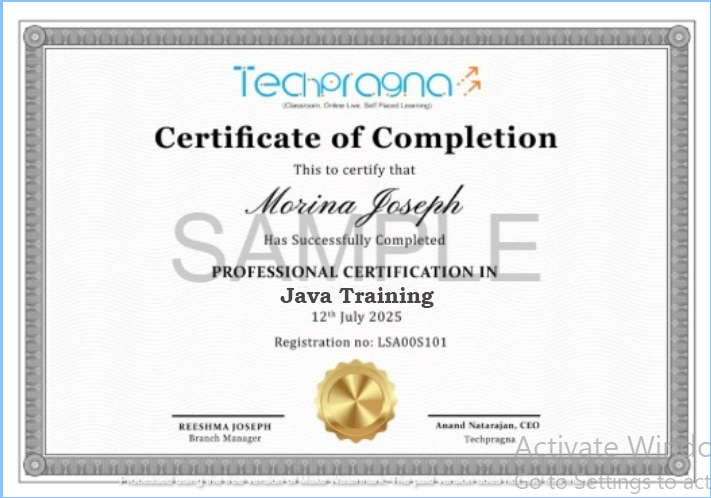
Will I get a certificate after completion?
Yes, the course is designed for beginners from any educational or professional background.
What’s the difference between frontend and backend?
Answer:
Frontend: What users see (UI, animations, forms).
Backend: Server logic, databases, APIs (hidden from users)
Is Python or Node.js better for backend?
Answer:
Node.js: Faster for real-time apps (chat, streaming).
Python (Django/Flask): Better for data-heavy apps (AI, analytics)
Is this course available online or offline?
Tech Pragna are offered in both online and offline
How do I practice full stack skills?
Answer:
Code daily: FreeCodeCamp, LeetCode.
Clone apps: Build a Netflix/Twitter clone.
Contribute to open-source
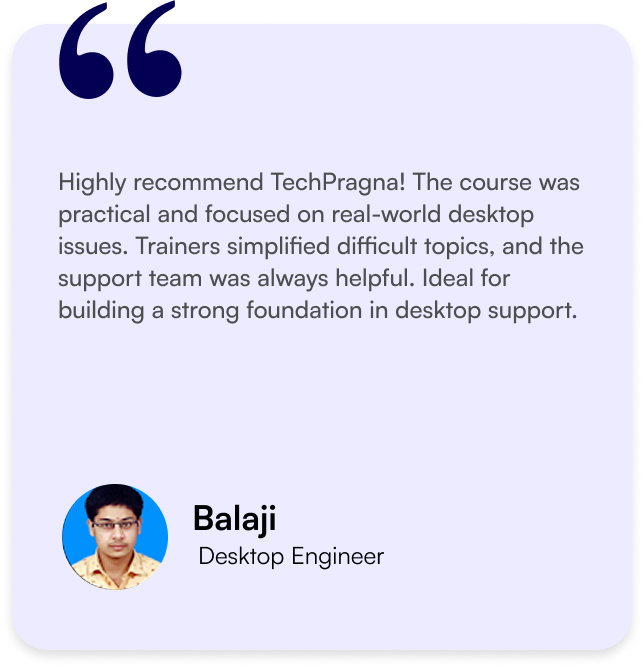
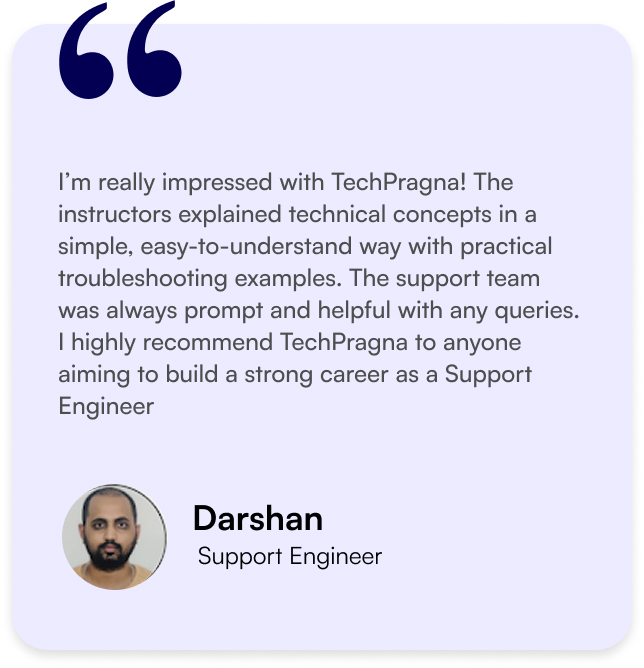
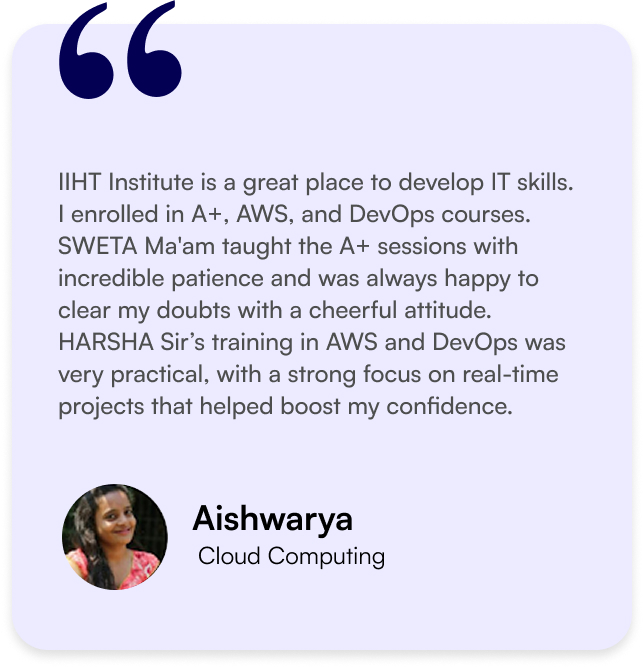
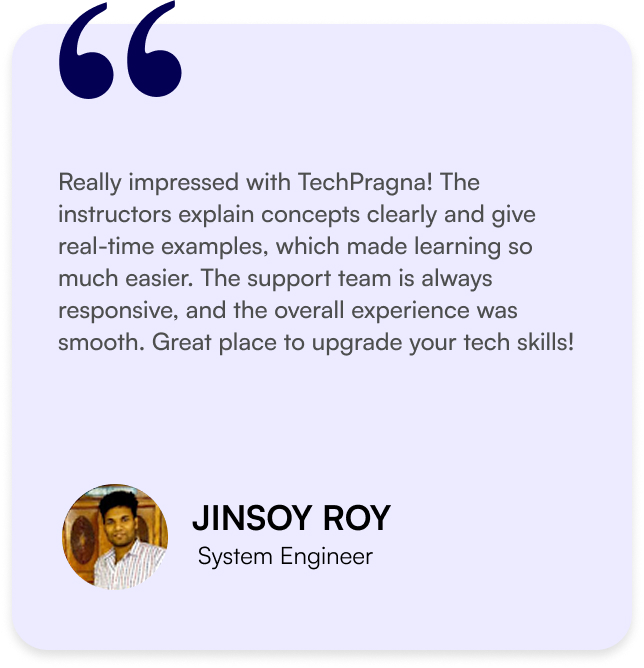
What Our Learners Have To Say
Explore the Latest Trending Courses
Explore the Latest Trending Courses

Software Testing
- Online/Offline
- 6 Months
- Professional Level Certification
- Projects and Case Study
Data Science
- Online/Offline
- 6 Months
- Professional Level Certification
- Projects and Case Study

Network Engineering
- Online/Offline
- 6 Months
- Professional Level Certification
- Projects and Case Study

Cyber Security
- Online/Offline
- 6 Months
- Professional Level Certification
- Projects and Case Study