Data Science
Attain mastery through practical, project-based learning on real-world datasets with Data Science Training in Bangalore.
- Get absolute mastery in tools such as Python, SQL, Machine Learning, Power BI, Tableau, and Statistics.
- Interactive classroom and online live training sessions taken by thorough professionals.
- Expertise and proficiency in key skills – data cleaning, data exploration, predictive analysis, and business intelligence.
- Guaranteed placement with assistance.

World-Class Instructors

1:1 with Industry Mentors

55% Avg. Salary Hike

Interview Preparation
World-Class Instructors
1:1 with Industry Mentors
55% Avg. Salary Hike
Interview Preparation
Data Science Course: Highlights
A life-changing data science course with a life-changing software training institute accelerates your career and takes you to great heights. Equip yourself with the skills and techniques in data collection, data cleansing, data analysis, and model data with revolutionary methods and machine learning. Open to beginners and working professionals from all educational backgrounds!
Data Science Training – Key Features
- Interactive classroom and online sessions.
- Expertise in tools demanded by the industry.
- Flexible hours of learning
- Add-on career services: resume building, mock interviews, and job boards.
- Industry-based curriculum
- Hands-on experience through live projects.
Request more information
What You’ll Learn Learn
Accelerate your career in data with our Data Science Training at TechPragna in Bangalore. This comprehensive course equips you with the skills and techniques to collect, clean, analyze, and model data using advanced statistical methods and machine learning—perfect for both beginners and working professionals looking to build a successful data science career
Data Science Training – Key Features
- Master Essential Tools: Python, SQL, Power BI, Tableau, Excel, and Scikit-learn
- Live online and offline interactive sessions from top industry professionals
- Guaranteed placement support through our career advancement services
- Benefit from guaranteed placement assistance with dedicated career support services.
- Receive guaranteed placement assistance with resume building and interview preparation
- Attend online and offline sessions led by top data science industry experts.
Request more information
Data Science Course Curriculum
Module 1: Introduction to Data Science
- Definition and importance of Data Science
- Role of a Data Scientist in industry
- Types of data: structured, unstructured, semistructured
- Data Science vs AI vs Machine Learning vs Big
Data - Applications of Data Science in real-world
scenarios - Career opportunities and job roles in Data
Science - Overview of tools and technologies used in Data
Science
Module 2: Python for Data Science
- Python basics: variables, data types, operators
- Control structures: loops and conditional statements
- Functions, modules, and packages
- Python libraries: NumPy, Pandas
- Data handling with Pandas
- Data visualization with Matplotlib & Seaborn
- Mini project: Basic data analysis on a dataset
Module 3: Statistics and Probability
- Descriptive statistics: mean, median, mode, variance, standard deviation
- Probability concepts: events, conditional probability, Bayes theorem
- Inferential statistics: hypothesis testing, confidence intervals
- Correlation and covariance
- Sampling techniques and distributions
- Central Limit Theorem
- Mini project: Analyzing sample survey data
Module 4:Data Cleaning and Preprocessing
- H andling missing and duplicate data
- Data normalization and scaling
- Encoding categorical variables
- Outlier detection and treatment
- Feature engineering techniques
- Data preprocessing for machine learning
- Mini project: Cleaning a retail dataset
Module 5:Data Visualization
- mportance of visualization in Data Science
- Basic plots with Matplotlib
- Advanced visualization with Seaborn
- Interactive dashboards using Plotly
- Tableau basics and connecting datasets
- Creating actionable insights through visualizations
- Mini project: Sales dashboard creation
Module 6: SQL for Data Science
- ntroduction to databases and SQL
- Basic SQL queries: SELECT, INSERT, UPDATE, DELETE
- Aggregate functions: COUNT, SUM, AVG, GROUP BY
- Joins: INNER, LEFT, RIGHT, FULL OUTER
- Subqueries and nested queries
- Indexing and query optimization
- Mini project: Analyzing customer transaction data
Module 7: Machine Learning Basics
- uper vised vs unsupervised learning
- Regression algorithms: Linear, Multiple, Logistic
- Classification algorithms: KNN, Decision Trees, Random Forest
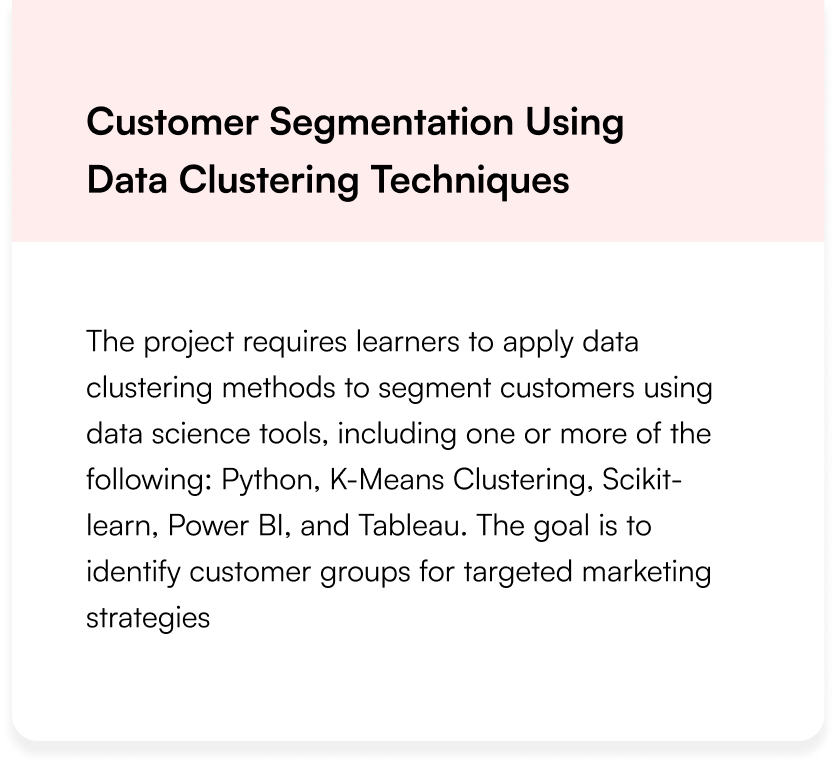
- Clustering: K-Means, Hierarchical
- Model evaluation metrics: accuracy, precision, recall, F1-score
- Train test split and cross-validation
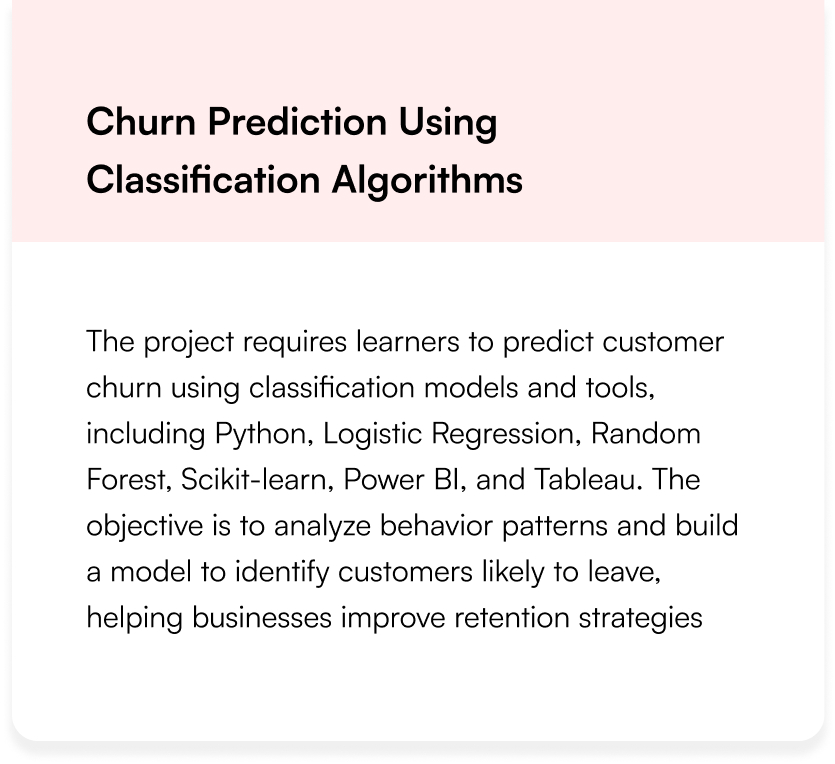
- Mini project: Customer churn prediction
Module 8: Advanced Machine Learning
- Support Vector Machines (SVM)
- Ensemble methods: Bagging, Boosting, XGBoost
- Dimensionality reduction: PCA
- Feature selection techniques
- Hyperparameter tuning: GridSearch, RandomSearch
Handling imbalanced datasets
Mini project: Fraud detection in transactions
Module 9: Natural Language Processing (NLP)
- ntroduction to NLP and its applications
- Text preprocessing: tokenization, stemming, lemmatization
- Bag of-Words and TF IDF models
- Sentiment analysis
- Named Entity Recognition (NER)
- Word embeddings: Word2Vec, GloVe
- Mini project: Twitter sentiment analysis
Module 10: Deep Learning
- Introduction to neural net works
- Activation and loss functions
- Deep learning frameworks: TensorFlow, Keras, PyTorch
- Convolutional Neural Networks (CNN)
- Recurrent Neural Networks (RNN)
- Regularization techniques: dropout, early stopping
- Mini project: Image classification using CNN
Module 11: Big Data & Cloud
- ntroduction to Big Data concepts
- Hadoop ecosystem and HDFS
- Apache Spark for large-scale data processing
- Cloud platforms: AWS, Azure, GCP
- Big Data analytics tools: Hive, Pig
- Real-time data processing using Spark Streaming
- Mini project: Large dataset analysis on cloud
Module 12: Data Analytics with Excel & Power BI
- Advanced Excel functions for analytics
- Pivot tables and charts
- Conditional formatting and data validation
- Power BI Desktop: data import and transformations
- Creating interactive dashboards in Power BI
- DAX formulas for calculations
- Mini project: Customer and sales analytics dashboard
Module13 :Time Series Analysis & Forecasting
- ntroduction to time series dat a
- Trend, seasonality, and residuals
- Moving averages and exponential smoothing
- ARIMA and SARIMA models
- Forecasting using Prophet
- Model evaluation metrics for forecasting
- Mini project: Stock price prediction
Module14: Data Science Project Lifecycle
- Understanding CRISP-DM methodology
- Problem definition and data collection
- Data cleaning and preprocessing
- Exploratory Data Analysis (EDA)
- Model building and evaluation
- Reporting and visualization
- Mini project: End-to-end data science project
Module15: Capstone Project
- Selecting a real-world dataset (Finance, Healthcare, Retail, etc.)
- Defining objectives and KPIs
- Data preprocessing and cleaning
- Exploratory Data Analysis (EDA)
- Model building: predictive or analytical models
- Dashboard creation and visualization
- Presenting insights and business recommendations
Master In-Demand Skills with Practical, Industry-Based Learning
Data Science Career Path
Data Scientist:
Consequently, a Data Scientist forecasts current and upcoming marketing trends using advanced statistical methods, including machine learning and predictive modeling.
Machine Learning Engineer:
A machine learning engineer is involved in developing, testing, and deploying machine learning models for automated decision-making and predictive tasks.
Data Science Consultant:
On the other hand, a data science consultant provides expert advice on best practices for implementing designed strategies and innovative technologies required to harness data science for the betterment of business.
AI Engineer
The AI engineer’s role is that of a software developer who uses existing AI tools and pre-trained models to enhance user experiences.
NLP Engineer
An NLP Engineer builds systems that bridge the communication gap between humans and computers, using tools such as smart assistants and language translators.
Applied Data Scientist
An Applied Data Scientist’s role is to fill the gap between theory and practical implementations in data science. They focus extensively on building, training, and deploying learning models for production to solve real-world problems.
Skills that you will learn in the Data Scientist Course in Bangalore
Techpragna covers the robust skills for the Data Scientist Course in Bangalore.
Advanced Excel
Statistical Analysis
Advanced Excel
SQL Querying
Data Visualization
Python Programming
Exploratory Analysis
Machine Learning
Data Storytelling
Business Intelligence
12+ Data Science Tools Covered

Data Analyst
Collects, processes, and interprets data to generate actionable insights through reports and dashboards that support business decisions.
Business Analyst
Bridges the gap between business objectives and data by analyzing processes and recommending data-driven solutions to improve performance
Data Scientist
Applies advanced statistical techniques, machine learning, and predictive modeling to extract insights, forecast trends, and solve complex problems
Data Engineer
Builds and maintains scalable data pipelines and architectures, ensuring reliable data collection, cleaning, and availability for analysis
Machine Learning Engineer
Develops, tests, and deploys machine learning models into production environments to automate decision-making and predictive tasks.
Data Science Consultant
Advises organizations on best practices, strategies, and technologies to harness data science for business growth and innovation.
Skills Covered
Data Cleaning
Statistical Analysis
Advanced Excel
SQL Querying
Data Visualization
Python Programming
Exploratory Analysis
Machine Learning
Data Storytelling
Business Intelligence
12+ Data Science Tools Covered

Career Services


Personalized Guidance

Resume Preparation and Mock Interviews

1:1 interactive sessions – online and offline

Project assistance from the faculty.

Practical exposure through live projects

100% Guaranteed Placement
Career Services
Placement Assistance
Personalized Guidance
Mock Interview Preparation
One-on-One Mentoring session
Career Oriented Seesions
Resume & LinkedIn Profile Building
How our program works
Enhance Your Skills to Transform Your Career Path
- Transform your classroom training into an office environment with 100% practical projects – real-world case studies and company-based assignments.
- Build an impressive portfolio that makes recruiters keep you in mind for hiring.
- Practical learning and guidance from industry professionals to gain valuable insights that push the boundaries of course materials and theory.
- Prove your worth with technical skills, business knowledge, understanding, and competence.
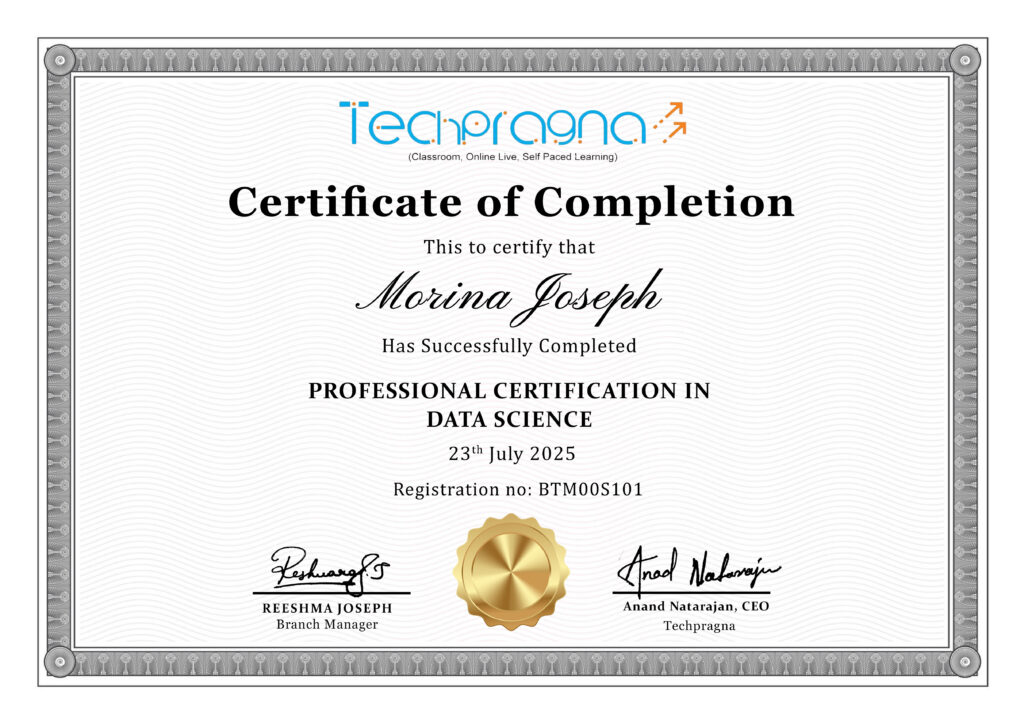
- Build a formidable portfolio with industry certificates and interview-ready skills that make employers want to hire you.
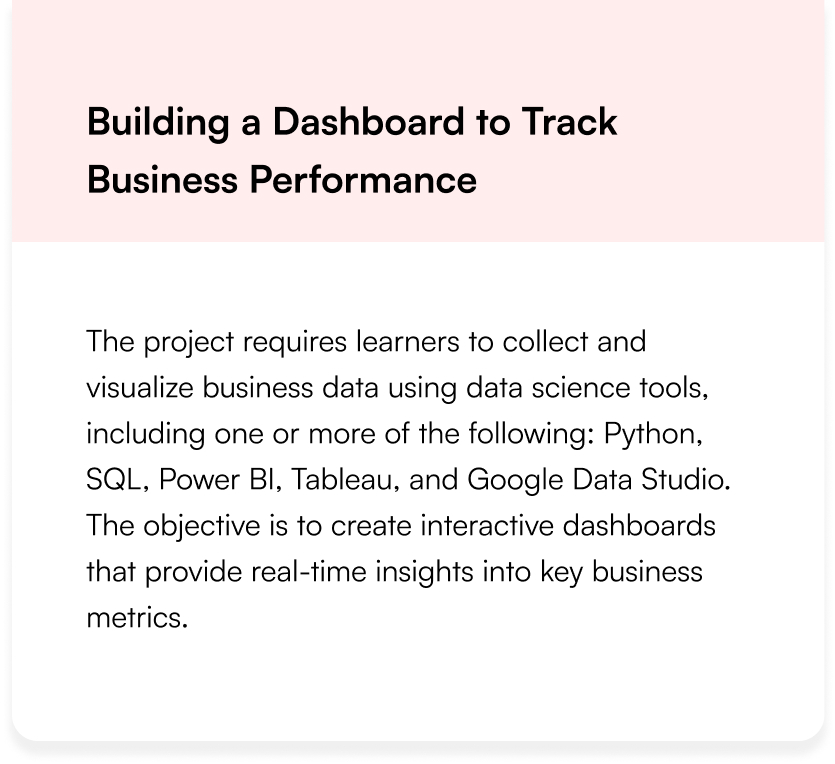
Projects for Data Science
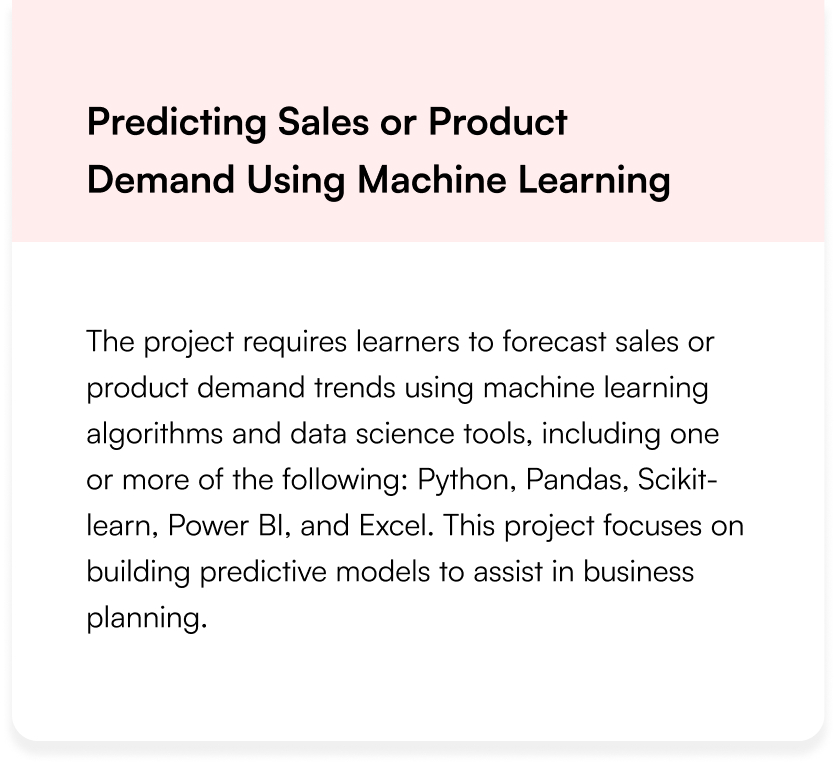
Data Science Projects Covered
Land Your Dream Job Our Alumni
Land Your Dream Job Our Alumni
Data Science Training FAQs
What are the prerequisites for learning Data Science?
Answer:
Basic math (statistics, linear algebra)
Programming (Python or R)
SQL for databases
No strict prerequisites for beginners; many courses start from scratch.
Which is better for Data Science: Python or R?
Answer:
Python: Versatile, better for production and ML.
R: Strong in statistical analysis and visualization.
Most professionals use Python for its broader ecosystem (TensorFlow, PyTorch).
Do I need a degree to become a Data Scientist?
Answer:
No! Many Data Scientists come from non-traditional backgrounds. Employers value:
Skills (Python, ML, SQL)
Portfolio projects
Certifications (e.g., Google Data Analytics, IBM Data Science)
What tools/languages should I learn first?
Answer:
Python (Pandas, NumPy, Scikit-learn)
SQL (PostgreSQL, MySQL)
Visualization (Matplotlib, Tableau)
Big Data (Spark, Hadoop).
What’s the difference between Data Analyst and Data Scientist?
Answer:
Data Analyst: Focuses on descriptive analytics (SQL, Excel, dashboards).
Data Scientist: Builds predictive models (Python, ML, advanced stats).
Is this course available online or offline?
Tech Pragna are offered in both online and offline
What industries hire Data Scientists?
Answer:
Tech, healthcare, finance, e-commerce, marketing, and more. High demand in:
Finance: Fraud detection
Healthcare: Predictive diagnostics
Retail: Recommendation systems.
Data Science Training FAQs
What are the prerequisites for learning Data Science?
Answer:
Basic math (statistics, linear algebra)
Programming (Python or R)
SQL for databases
No strict prerequisites for beginners; many courses start from scratch.
Which is better for Data Science: Python or R?
Answer:
Python: Versatile, better for production and ML.
R: Strong in statistical analysis and visualization.
Most professionals use Python for its broader ecosystem (TensorFlow, PyTorch).
Do I need a degree to become a Data Scientist?
Answer:
No! Many Data Scientists come from non-traditional backgrounds. Employers value:
Skills (Python, ML, SQL)
Portfolio projects
Certifications (e.g., Google Data Analytics, IBM Data Science)
What tools/languages should I learn first?
Answer:
Python (Pandas, NumPy, Scikit-learn)
SQL (PostgreSQL, MySQL)
Visualization (Matplotlib, Tableau)
Big Data (Spark, Hadoop).
What’s the difference between Data Analyst and Data Scientist?
Answer:
Data Analyst: Focuses on descriptive analytics (SQL, Excel, dashboards).
Data Scientist: Builds predictive models (Python, ML, advanced stats).
Is this course available online or offline?
Tech Pragna are offered in both online and offline
What industries hire Data Scientists?
Answer:
Tech, healthcare, finance, e-commerce, marketing, and more. High demand in:
Finance: Fraud detection
Healthcare: Predictive diagnostics
Retail: Recommendation systems.
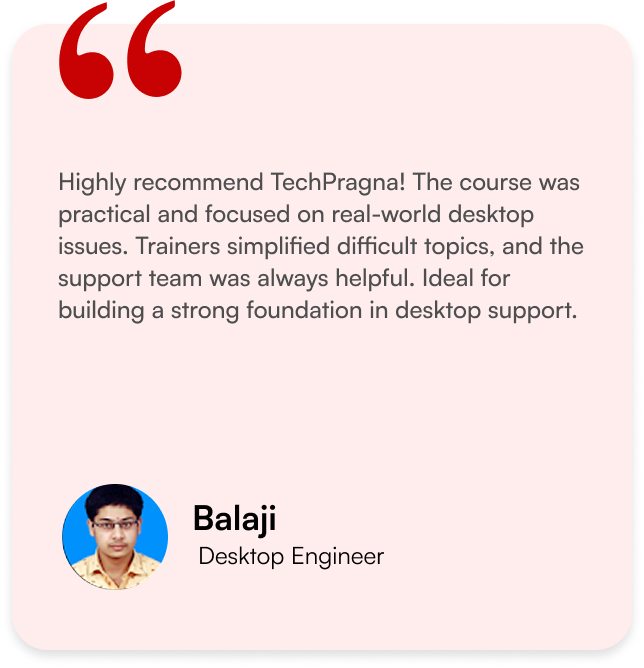
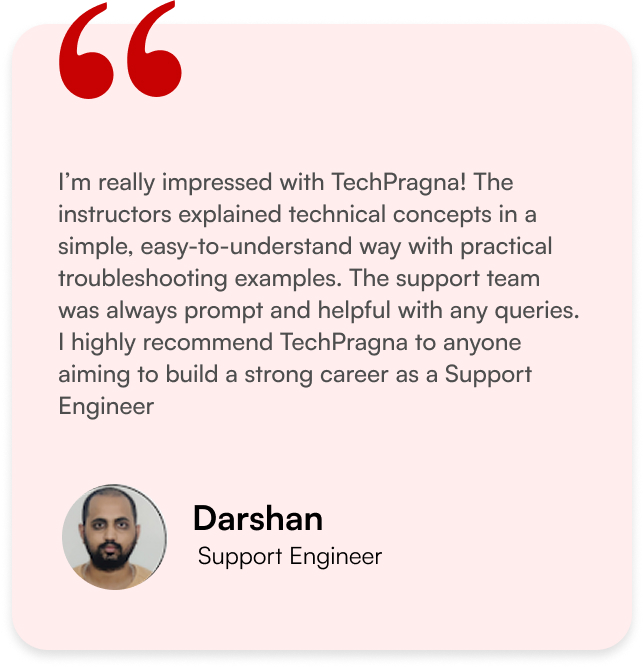
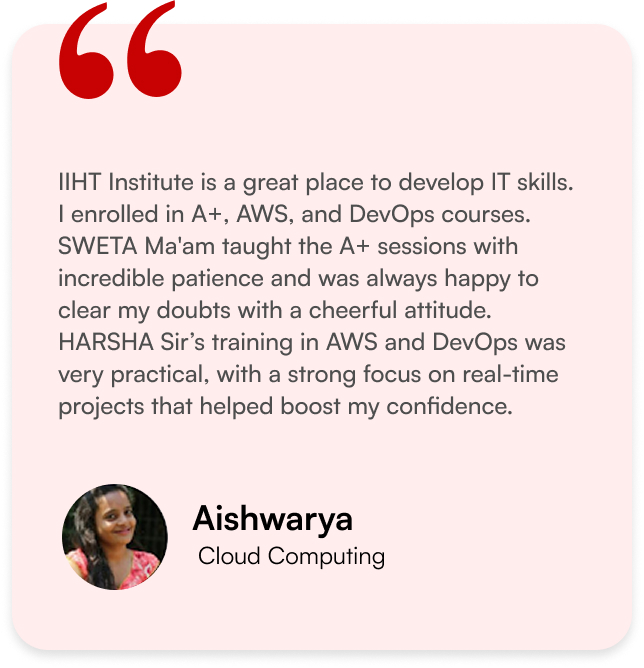
What Our Learners Have To Say
What Our Learners Have To Say

Explore the Latest Trending Courses
Explore the Latest Trending Courses

Software Testing
- Online/Offline
- 6 Months
- Professional Level Certification
- Projects and Case Study

Full Stack Development
- Online/Offline
- 6 Months
- Professional Level Certification
- Projects and Case Study

Network Engineering
- Online/Offline
- 6 Months
- Professional Level Certification
- Projects and Case Study

Cyber Security
- Online/Offline
- 6 Months
- Professional Level Certification
- Projects and Case Study
Software Testing
- Online/Offline
- 6 Months
- Professional Level Certification
- Projects and Case Study
Full Stack Development
- Online/Offline
- 6 Months
- Professional Level Certification
- Projects and Case Study

Network Engineering
- Online/Offline
- 6 Months
- Professional Level Certification
- Projects and Case Study
Cyber Security
- Online/Offline
- 6 Months
- Professional Level Certification
- Projects and Case Study